2026 Milano Cortina Winter Olympics
Written by Diana Thebaud Nicholson // February 22, 2026 // Olympics // Comments Off on 2026 Milano Cortina Winter Olympics
As the climate changes, what does the future hold for the Winter Olympic and Paralympic Games?
Daniel Scott, Professor and Strategic Director for Climate Change Education in Environment, University of Waterloo ; Madeleine Orr, Assistant Professor, Sport Ecology, University of Toronto ; Robert Steiger Associate Professor, Department of Public Finance, University of Innsbruck
For the Winter Olympic and Paralympic Games, climate change could fundamentally impact where the Games can be held in the future. In 2022, the International Olympic Committee delayed the selection of the 2030 host city so that it could obtain a clearer understanding of the climate risk of potential future host locations.
(The Conversation) The schedule at the 2026 Milano Cortina Winter Olympics is set to look similar to previous iterations of the event: a mix of snow and ice sports held on what is meant to be mountainous, wintry terrain.
Except the snowy cold winter that comes to mind when you picture the Olympic Games may not be tenable for much longer. Climate change is reshaping winter sport worldwide. In the Northern Hemisphere, the winter season has shortened over the last 50 years, with low elevation regions warming at twice the rate of global warming, leading to widespread declines in snowpack.
Snow sport athletes are experiencing these changes firsthand. In recent years, several International Ski and Snowboard Federation World Cup events have been cancelled due to poor snow and unsafe conditions.In 2023, nearly 300 concerned athletes sent a letter to the federation demanding more action on climate change and a “geographically reasonable” race schedule aligned with evolving weather realities.
22 February
AP photographers pick their favorite photos from the Milan Cortina Olympics
Highlights from the Milano Cortina Winter Olympics closing ceremony -Reuters Photos
Spread-out Milan Cortina Olympics might be the blueprint for future Games
“We pioneered an organizational model, that of a widespread Games that has proven to be successful,” the CEO of 2026 Games said.
Coincidences
The USA hockey team defeated Canada on Feb 22, the same date (in 1980) that the USA team defeated the Soviet team at the XIII Olympics at Lake Placid.
The captains of both the women’s and men’s hockey teams were injured and unable to play in the final game.
Both teams lost to the USA in overtime.
Joy and pain for the U.S. and Canada, and a hockey game that had all the feels
“I think it’s probably gonna go down as one of the greatest games ever played,” American defenseman Jake Sanderson said
(WaPo) …Team Canada sat still as stone, huddled on the bench as if bracing from an unrelenting chill. This was a horror movie for those 22 men, not to mention the people in the great expanse from Yukon to Newfoundland. In the stillness was pain. Hockey is the Canadians’ sport. It’s not an overstatement to say, for some, it’s an identity. Toss in the indignities of tariffs and ridiculous threats of annexation from the United States, and Sunday’s gold medal game — the thriller that closed the Milan Cortina Olympics — carried another level of meaning.
The goal that decided gold came from the stick of Jack Hughes, the fresh-faced 24-year-old star of the New Jersey Devils, 101 seconds into overtime. It’s worth discussing the merits of deciding something as weighty and worldly as a gold medal with an extra session that is contested just three-on-three, wide open, tricked-up hockey. The time for that discussion is not now. The two teams knew the rules before the puck was dropped. Hughes’s goal won it fair and square.
21 February
Watching the Olympics in Ukraine
One world enables another
Timothy Snyder
(Substack) It is a rough Olympics, seen from Ukraine. War is an everyday reality, touching everything. Russia began a full-scale invasion of Ukraine right after the last Winter Olympics, so four years ago, and has killed hundreds of Ukrainian athletes.
“… so I turn to the internet for the American summaries. We differ from others in how we do this. During these Olympics I have watched the Norwegians and the Austrians and the Slovaks and the Canadians as well as the Americans. While everyone is more or less nationalist and no one is perfect, we do stand out in a specific way: our obsession with winning and flashing bling.
I don’t want to be unfair. The American athletes have various perspectives. And some of our commentators do inject notes of expertise or empathy. But a good deal is just the repetition of something that everyone already knows: if the athlete wins they get a medal. Before the event starts we are told to imagine the podium at the end. The performance itself is compressed into a prelude to winning or losing.
The emphasis on getting gold doesn’t seem innocent: not in a moment when the American president paints his face gold, demands golden prizes, and tells whole countries that he wants their minerals.”
18 February
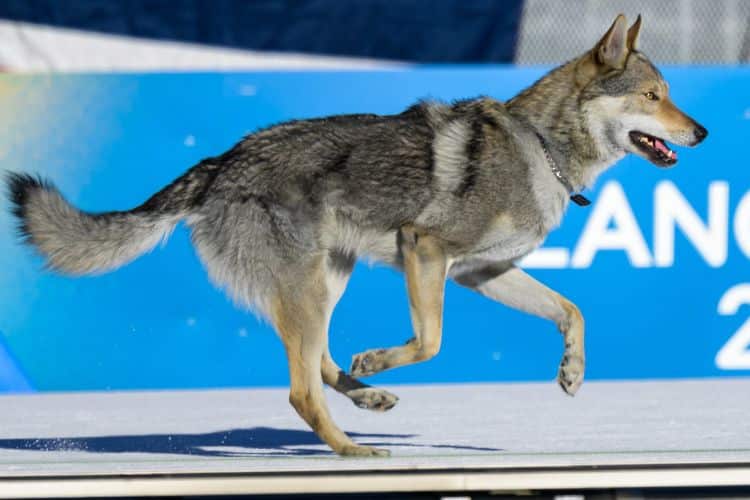 Very good dog invades course but falls short of medal glory at Winter Olympics
Nazgul makes unexpected entry in team sprint
A local dog has missed out on a historic cross-country medal at the Winter Olympics despite a lung-bursting surge in the homestretch.
Even if he had completed the entire race, Nazgul’s time would not have counted as he is male. And a dog.
Greece’s Konstantina Charalampidou said Nazgul appeared intent on finding fame rather instead of concentrating on his race plan.
“He was chasing the camera that goes up and down the finish line. He was cute but not aggressive,” she said. “I wanted to pet him, but I didn’t have the time and I couldn’t find him afterwards.”
Nazgul’s owner told NPR the two-year-old was probably looking for company rather than athletic glory.
This Olympic ritual offers a lesson about money
Olympians bite their medals to test their purity. It used to be the same with currency.
12-18 February
Ukraine skeleton racer gifted $200,000 by Shakhtar owner after Winter Olympics ban
Donation equal to prize Ukraine pays gold medallists
Heraskevych barred for wearing ‘helmet of memory’
The owner of Ukrainian football club Shakhtar Donetsk has donated more than $200,000 to skeleton racer Vladyslav Heraskevych.
Disqualified at the Olympics, Ukrainian skeleton racer gains a different top honor
“Ukraine’s greatest asset is Ukrainians,” the country’s president said in awarding the medal.
The presentation to Vladyslav Heraskevych was made in Munich on Thursday, where world leaders are gathered for a security conference.
SHAME on IOC
Ukrainian athlete Heraskevych out of Winter Olympics over banned helmet
‘The helmet does not violate any IOC rules,’ Heraskevych said
Ukrainian skeleton athlete Vladyslav Heraskevych, a likely medal contender at the Milan-Cortina Winter Games, was barred from racing on Thursday after refusing a last-minute plea from the International Olympic Committee to not use a helmet that honours more than 20 athletes and coaches killed in his country’s war with Russia.
The decision came roughly 45 minutes before the start of the competition and ended a three-day saga where Heraskevych knew he was risking being pulled from the Games by wearing the helmet, which the IOC says breaks rules against making statements on the field of play.
18 February
Italy’s blades of glory deliver a lights-out performance
Davide Ghiotto, Andrea Giovannini and Michele Malfatti thrashed the world record-holders, world champions and favourites Casey Dawson, Emery Lehman and Ethan Cepuran of the US to win the men’s team pursuit gold medal in speed skating. Buoyed by raucous cheering from the home crowd, the Italians won their country’s first Olympic title in this event since the Turin Games in 2006, beating the Americans by a whopping 4.51sec – a lifetime in speed skating.
17 February
‘The whole spirit of curling is dead’: meltdown on the ice as ruckus rumbles on
Row between Sweden and Canada over accusation of double-touch continues to cast shadow over Winter Games
16 February
Determined and desperate, Canada captain Poulin wills her team back to another Olympic final
Dominant American team stands between Canada and gold, but the Canadians have belief
Olympic skating has a new addition: A backward-skating cameraman (video)
Former U.S. competitive ice dancer Jordan Cowan is the first camera operator on figure skating ice in Olympic history, capturing intimate moments that the overhead or sideboard cameras cannot.
‘I just needed some time for myself’: Norwegian skier hides in woods after slalom gold heartache
For more than a century of Winter Olympic sport, athletes have dealt with defeat in almost every possible way: tears, tantrums, breaking things, breaking down. But on Monday afternoon in Bormio, the Norwegian Atle Lie McGrath processed his grief in a novel way after the men’s slalom gold medal suddenly slipped away. First, he threw his ski poles as far as he could. Then he hid in the woods.
13 February
Bravo! Act I of the Winter Olympics’ visit to Italy has been filled with drama, catharsis and tears
By Will Graves
(AP) — Soaring arias. Wrenching tragedy. Joyful triumphs. Exotic backdrops. Climaxes often designed to produce tears, sad or otherwise. Perhaps more than anything, the operas that Italians began creating 400 years ago are designed to make you feel
No wonder the country that invented the art form where music and poetry merge, and these Winter Olympics seem to be such a perfect fit.
The quadrennial spectacle that began its stay in Northern Italy with a gala hosted by the International Olympic Committee at the iconic La Scala opera house in Milan spent its first full week reflecting the host country’s signature art form onto itself.
12 February
How Indigenous athletes challenge simple ideas of national unity at the Olympics
Taylor McKee, Assistant Professor, Sport Management, Janelle Joseph, Assistant Professor, Critical Studies of Race & Indigeneity, University of Toronto; Brock University; Lucas Rotondo, Master’s Student in Applied Health Sciences, Brock University
(The Conversation) …for most nations, the importance of the Olympics extends well beyond medals.
The Games are a place where nations tell stories about themselves: who belongs, who represents them and how secure that nation feels in the world. National sporting events offer a way to make abstract ideas like sovereignty and belonging visible.
As humanities scholar Homi K. Bhabha argues in his book on nationhood, nations are not fixed entities, but are continually retold, like stories. The Olympics provide one of the most visible stages for nations to shape narratives about themselves.
At a time when Canada and other countries are feeling pressure about their sovereignty, the Olympic Games are taking on heightened symbolic meaning.
But Indigenous athletes, in particular, reveal the limits of using sport to perform national unity, and show how multiple sovereignties continue to exist within “Team Canada.” …
‘Are You Feeling the Vibe?’ At Italy’s Spread-Out Olympics, It Depends.
In Milan, the hub of the Winter Games, the atmosphere seems subdued, while the small towns hosting mountain events are seeing enthusiastic crowds.
(NYT) The name of these Games might be Milan, but fans say that it’s in mountain towns that the essence of the Winter Olympics has come alive.
Gilles, Poirier surprise Canadian fans in Milan pub after earning Olympic bronze medal
The pair, who have skated together for 15 years, were four-time medallists at the World Figure Skating Championships. Now in their third Olympic appearance together, they have finally broken through to climb onto the podium.
Broken legs, skier’s thumb and ‘sled head’: just some of the injuries risked by Winter Olympians
(The Conversation) The sports featured at the Winter Olympics defy gravity and physics. Many competitors move at breakneck speeds down steep, snowy inclines or careen across icy surfaces in a bid to set world records and earn their place on the podium.
But as exciting as these events are for spectators, they also place competitors at serious risk of injury. This is something we have been reminded of after US alpine ski racer Lindsey Vonn fractured her leg during a horror crash just seconds into her downhill run in the Milan Cortina games.
Of course, this isn’t the first time a Winter Olympian has suffered injury at the Games. Four athletes have died during Winter Olympic events or in preparation for them – most recently, Georgian luge athlete Nodar Kumaritashvili, who died after colliding with a wall during a training run at the 2010 Winter Olympics in Vancouver, Canada.
But of the 15 sports disciplines featured at this year’s Winter Olympics, a few stand out in terms of their riskiness to competitors:
Of the snow-based events, skiing and snowboarding appear to be the most risky.
‘Knitting and the flow state’
Biathlete Adam Runnalls says he uses knitting as a way to relax before his races.
There’s been a lot of talk about accessing flow state ahead of snowboarders dropping into the women’s halfpipe final in Livigno.
It’s a mental zone that an athlete channels to be completely focused in order to deliver their peak performance.
Canadian biathlete Adam Runnalls is one of many knitters at the Olympics Games.
The Olympian is knitting a sweater on the side of these Games.
American alpine skier Breezy Johnson is doing the same.
9 February
Poulin injured in Canada women’s win over Czechia;
(CTV) captain Marie-Philip Poulin exited in the first period and did not return for the final 40 minutes with an apparent knee injury. Poulin was checked by Kristyna Kaltounkova midway through the opening frame and skated off, favouring her right knee.
8 February
Vonn’s Olympic comeback over after crashing out, seconds into downhill run
(CBC) U.S. alpine ski racer Lindsey Vonn’s Olympic comeback dreams are over after she crashed hard about 13 seconds into her downhill run at the Milano-Cortina Olympics. Vonn was airlifted off the slope and taken to surgery.
How figure skating and copyright law became ‘despicable’ opponents, and the Canadian pair caught in middle
Effort to modernize sport didn’t anticipate musicians’s reaction
(CBC) The plight of Tomas-Llorenc Guarino Sabate, a Spanish skater who has performed a popular Minions-themed program to a medley of four “Despicable Me” songs all season, gained widespread attention last week when he went public with his fears that he wouldn’t receive permission to use the music at the Winter Olympics in time.
Perhaps because of mounting pressure from skating and Minions fans around the world, Sabate received his final clearance, for a cut from the Pharrell Williams song “Freedom,” on Friday.
… In October 2014, to modernize the sport and appeal to younger audiences, figure skating authorities began allowing singles and pairs skaters — previously limited to instrumental music that was often ancient and in the public domain — to use songs with lyrics for the first time.
That decision led to a revolution in on-ice performance but also an unintended off-ice consequence: Musicians began objecting to the royalty-free use of their own art, especially when it was widely broadcast during the Olympics.
6 February
How this Quebecer became Venezuela’s only athlete at the Milano-Cortina Olympics (video)
Twenty-year-old Nicolas Claveau-Laviolette was born in Venezuela but, prior to January, he hadn’t set foot in the country since he was two years old. Now, he’ll proudly sport red, blue and yellow at the Milano-Cortina Olympics as Venezuela’s only athlete.
View entire Opening Ceremony on Gem (249 minutes)
Opening Ceremony did not garner rave reviews from Globe & Mail reporters:
Opening ceremony wins Olympic gold in platitudes
The Olympics pablum is reaching its crescendo. … These are the platitudes we’re all forced to endure when we choose to sit through an opening ceremony
NOT a platitude was Andrea Bocelli’s performance of Nessun Dorma – thrilling!
Canada, Ukraine earn massive cheers at opening ceremony as JD Vance booed
One of our favorite stories: How this Quebecer became Venezuela’s only athlete at the Milano-Cortina Olympics
Twenty-year-old Nicolas Claveau-Laviolette was born in Venezuela but, prior to January, he hadn’t set foot in the country since he was two years old. Now, he’ll proudly sport red, blue and yellow at the Milano-Cortina Olympics as Venezuela’s only athlete.
Olympic torch the lightest ever at the Games
Milan’s blue-hued torch has a name: “Essential.” It’s the brainchild of Carlo Ratti, a Turin inventor who teaches at the Massachusetts Institute of Technology. Made from recycled aluminum, it weighs less than 2.5 pounds – the lightest ever created for an Olympics ceremony.
Winter Olympics 2026: opening ceremony at Milan’s San Siro and beyond
(The Guardian) The showpiece event will be entered in Milan’s landmark San Siro stadium, featuring the Parade of Athletes and entertainment over the course of the nearly three-hour spectacle. About 60,000 people are expected to attend San Siro, including a US delegation led by vice-president JD Vance.
Because the Games are spread out across Italy, elements of the opening ceremony including the procession of athletes will also be conducted in three other locations. Moments will be beamed to the televised audience from Cortina in the heart of the Dolomite mountains, Livigno in the Italian Alps as well as Predazzo in the autonomous province of Trento.
There will be two cauldrons – an Olympic first – inspired by Leonardo da Vinci’s geometric studies: one in Milan, at the Arco della Pace and the other at Piazza Dibona in Cortina. The cauldrons will be lit simultaneously.
The geopolitics of the Winter Games
(International Intrigue) The Olympic Committee loves to pretend sport is some neutral, transcendental platform reserved for slow-motion, synth-backed feats of humanity. But no amount of slow-motion or synth can scrub the politics, and the Committee knows this. It is, after all, the same body that awarded actual Nazis the hosting rights for the (eventually cancelled) 1940 Winter Games, after Hitler had annexed Austria and taken Czechoslovakia.
Sure, sometimes politics might warm the cockles (whatever a cockle is) of your heart, like two Koreas united. Others might leave you with chills, like Putin spending the GDP of Tunisia on history’s most expensive games to burnish his image before his next invasion.
Anyway, for the wild world that is 2026, here’s hoping we see more warmth, less chills.
The Olympics Are a Show of Global Harmony. The World Is Anything But.
The Winter Games, which officially open in Italy on Friday, are rooted in international cooperation. That feels out of place to some in a world where old rules no longer apply.
Surprise four-man bob gold for Canada’s Emery
Whenever it is Winter Olympics time, we are reminded of the glorious Canadian bobsled team, founded byVic Emery and managed by dear friend Chuck Rathgeb, and its amazing victory at the 1964 Innsbruck Olympics
Hailing from French-speaking Montreal, Vic Emery fell in love with bobsleigh on a trip to the 1956 Olympic Winter Games at Cortina d’Ampezzo, and was spurred the following year to set up the Association de Bobsleigh des Laurentides with his brother John, all in a region and a country without a track to its name or a single elite bobsledder.
… Taking place on consecutive days, 6 and 7 February, runs three and four saw CAN-1 maintain its electrifying pace, registering the second-fastest time on the penultimate run and then going quickest of all on the last to register one of the biggest surprises of the Games as Canada won gold on its Olympic bobsleigh debut.
2 February
Milano Cortina 2026: Stunning venues ready for the Olympic Winter Games
Discover the mountains, rinks and stadiums that will take centre stage when the Games begin on Friday (6 February).
The signs are up. The rings are in place. The soon-to-be world-famous blues and greens of the Olympic Winter Games Milano Cortina 2026 have taken over.
Across Northern Italy – from Milano to Cortina, Livigno and beyond – the venues set to stage two weeks of Olympic competition for gold, silver and bronze are ready.
Now, it’s time to take a look at the stunning venues that will soon play host to Olympic history.