2026 G7 France
Written by Diana Thebaud Nicholson // June 17, 2026 // France, Multilateralism // Comments Off on 2026 G7 France
Dinner at Versailles, alpine air and an Iran agreement: How Trump made it through another G7
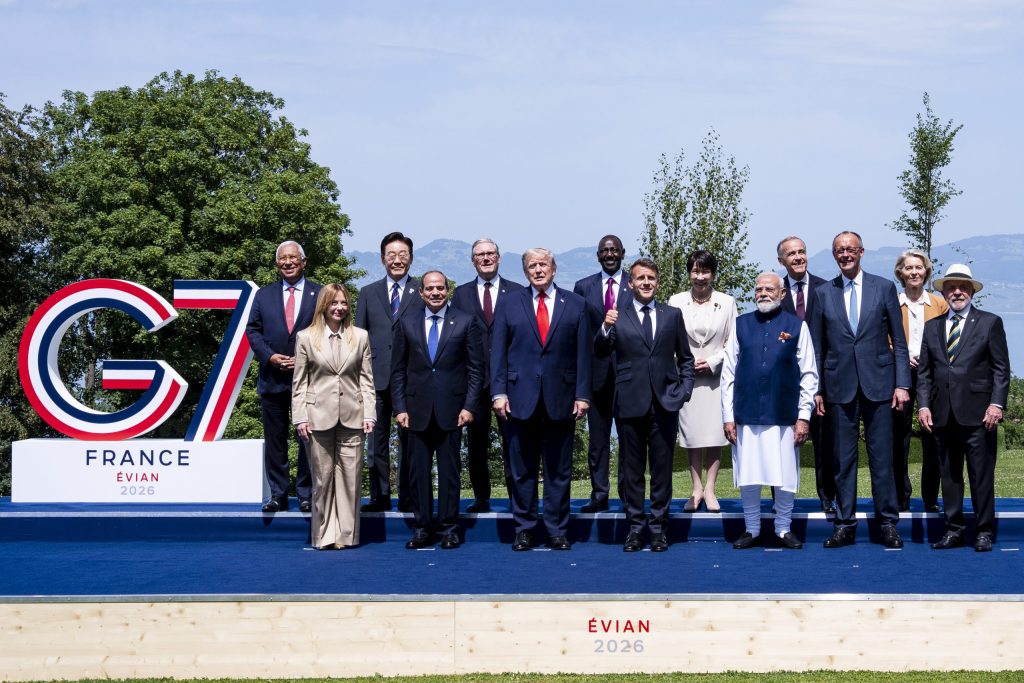
(CNN) For the first time in his two presidencies, Donald Trump attended a Group of 7 summit this week without blowing it up.
Sure, he complained when the temperature of the meeting room was too warm. He joked, upon arriving an hour late to one session, that he was his fellow leaders’ boss. The summit’s host, French President Emmanuel Macron, was caught on a hot mic describing an al fresco first-night dinner with Trump as a “difficult discussion.”
Yet Trump didn’t leave early, as he did last year in Canada, which was a baseline success for Macron, who had engineered the lakeside summit to ensure the US president stayed for the entire program.
“This was something very special,” Trump declared when the summit had ended.
Perhaps it was the alpine air. Perhaps it was the lingering sense of triumph at having brokered a preliminary deal with Iran, which received undiluted praise from his fellow leaders despite their lingering questions about how it will all be implemented.
Or maybe it was the anticipation of dinner at Versailles, tacked onto the schedule by Macron to ensure Trump remained in France for the summit’s conclusion.
G7 2026 Evian
15-17 June
23 years after the 2003 Evian G8 Summit and 7 years after the 2019 G7 Summit in Biarritz
presided over by the Head of State, Evian will once again be at the heart of international news
France’s 2026 G7 Presidency
Seven years after its previous Presidency, which culminated in the Biarritz Summit, France again took over the G7 Presidency on 1 January 2026.
The Leaders’ Summit will be held in Évian-les-Bains, from 15 to 17 June 2026.
Profound imbalances are threatening the stability of the global economy, leading to major commercial and geopolitical tensions and encouraging protectionist tendencies, to the detriment of shared growth. Reducing global imbalances is therefore the priority of France’s G7 Presidency.
France’s ambition is to restore the G7’s initial vocation, making it a forum for dialogue between major economic powers, both within and beyond its members themselves.
The Presidency will be organized around seven ministerial tracks: foreign affairs, development, trade, finance, the digital sector, the environment and home affairs. This structure will enable work on issues including:
Resolving major geopolitical crises;
Establishing a shared understanding of the causes of the excessive macroeconomic imbalances;
Overhauling the international solidarity system to form fairer and more effective global partnerships;
Securing value chains;
Developing reliable digital tools accessible to all;
Combating illegal flows and organized crime.
Almost 60 working groups will meet regularly throughout the year. Civil society will be represented in its full diversity by 13 engagement groups which will be involved in G7 work.
The French G7 Presidency will also be an opportunity to follow up on the international summits hosted by France in 2025: United Nations Conference to Support the Implementation of Sustainable Development Goal 14 : Conserve and sustainably use the oceans, seas and marine resources for sustainable development (UNOC, United Nations Ocean Conference), the Nutrition for Growth Summit, and the Artificial Intelligence Action Summit. It will also dovetail with other international events organized by France, like the One Health Summit and Africa Forward Summit.
17 June (1:30 am CET)
G7 promises to support Ukraine and sanction Russia in joint declaration
U.S. President Donald Trump signed the joint declaration after leaders in Evian unexpectedly converged on backing Kyiv.
(Politico) G7 leaders including U.S. President Donald Trump have backed a joint declaration promising to boost military support to Ukraine and to strengthen sanctions against Russia.
“We, the Leaders of the G7, stand united in our unwavering support for Ukraine in defending its freedom, sovereignty, and territorial integrity,” they said in a declaration published on Wednesday shortly after midnight.
G7 leaders “commit to increase the pressure on the Russian war economy” and to “strengthen our sanctions, including those on the oil and gas sectors,” they said.
The declaration name-checks Trump three times, saying that with the U.S. and Iran having reached an agreement to end hostilities, it is now easier to take more economic measures against Russia.
“We consider this the right moment to proceed with additional measures, as President Trump has delivered a deal that we support in reopening the Strait of Hormuz,” the declaration reads.
The leaders, who are meeting in Evian-les-Bains for a three-day G7 summit, also committed to “increase the delivery of air defence capacities, additional systems and interceptors, and long-range capabilities” to Ukraine and “to consider extending to Ukraine the benefit of licenses to allow for an increase in Ukraine’s military production.”
G7 commits to ‘unwavering support for Ukraine’
Despite some early concerns about Donald Trump’s position, the G7 leaders meeting in France have agreed on a statement declaring their “unwavering support for Ukraine in defending its freedom, sovereignty, and territorial integrity.”
G7 Leaders’ Joint Statements – Evian, France, 16-17 June 2026
At the 2026 G7 Leaders’ Summit held in Evian, the leaders of the G7 discussed topics ranging from international peace and security to global economic stability, growth, and emerging technologies. They adopted the following statements:
Leaders’ declaration on mutually beneficial international partnerships
Leaders’ call for a coordinated response to the Bundibugyo Ebola outbreak
Leaders’ call on the fight against cancer
G7 Leaders’ statement on geopolitical issues
Leaders’ declaration on tackling migrant smuggling
Leaders’ declaration on the fight against drug trafficking
Leaders’ call on a safer digital space for minors
Leaders’ statement for a more balanced, durable and resilient growth
G7 Leaders’ declaration on securing supply chains for critical materials
Kyle Matthews: The G7 Must Remain United
(Policy) … To say that the key grouping of the world’s leading democracies meets at a tumultuous time in history would be an understatement.
The greatest threat facing the G7 today, however, is not a disagreement over tariffs, burden-sharing, or even the latest diplomatic dispute between Washington and its allies. It is the growing challenge posed by authoritarian powers seeking to reshape the international order to their advantage.
That is why, despite President Donald Trump’s transactional and belligerent approach to foreign policy and his frequent criticism of America’s closest allies, the G7 cannot afford to fracture. At a moment marked by war in Europe, instability in the Middle East, economic uncertainty, and weakening global institutions, democratic unity remains a strategic imperative. …
After a Bitter Split, European Leaders Play Nice With Trump
A peace framework with Iran, and hope for cooperation with Ukraine, softened the tone on Tuesday at a Group of 7 gathering in France.
Europe’s alliance with the United States may still be on the rocks, but on the first full day of a Group of 7 summit meeting at this Alpine spa town in France, the leaders showed they remained ready to behave politely toward Mr. Trump.
For all the sharp elbows of the last year, they appear to have concluded that the best way to deal with a disruptive president is to court him, particularly since they still hope to engage the United States on thorny issues like the war in Ukraine.
15 June
The tyranny of low G7 expectations
(Politico) … On Tuesday morning, leaders will discuss support for Ukraine with Ukrainian President Volodymyr Zelenskyy, before moving on to a session on the crisis in the Middle East with leaders of Gulf countries, and then discuss international solidarity before attending a gala dinner.
On the last day, after a discussion on economic growth, leaders will have a lunch with artificial intelligence heavyweights including Sam Altman and Arthur Mensch and Anthropic CEO Dario Amodei — a gathering that comes on the heels of Anthropic disabling all access to its latest AI models after the American government ordered it to suspend access for non-U.S. users.
Expectations are low. Instead of the traditional joint communiqué issued by the world’s leading economies, heads of state are set to endorse declarations on specific issues, including research to fight cancer, online child protection, international solidarity, social impact investment and investment de-risking in fragile countries, with Macron set to issue summaries of geopolitical talks.
Addressing global macroeconomic imbalances — and China’s role in subsidizing exports that are disrupting global markets — the economic consequences of the war in the Middle East and the blockade of the Strait of Hormuz are also on the agenda.
The ‘Potential Risks’ of AI Singled Out in Draft G7 Statement
The Group of Seven leaders will “further discuss emerging opportunities and potential risks arising from AI, notably in the financial sector,” according to a draft statement seen by Bloomberg that’s subject to change.
A Sidelined G7 Awaits Trump’s Triumphant Arrival
The forum created to solve geopolitical crises was excluded from the US-Israeli planning for war on Iran and the diplomacy to end it.
(Bloomberg) … There is no agreed text. The draft that has circulated is a Persian-language version that reads like a series of concessions to Iran. The impression given is of a US president desperate to end the conflict before it drains his popularity even more.
That will make the personal dynamics at the G7 awkward.
A forum created to solve geopolitical crises, the group was excluded from the US-Israeli planning for war and the diplomacy to end it. The deal was announced the day before leaders meet and the signing will take place after they leave.
14 June
The G7 just wants to show it can work together. That may be too much to ask.
The muted ambitions from the United States and European countries reflect how the world has come to operate in the Trump era, in which avoiding a blowup and papering over differences with a message of cohesion is viewed as a win.
(Politico) A successful summit, in President Donald Trump’s eyes, would have his fellow leaders recognize their “shared mutual interests” while “opening up a line of dialogue” on topics they disagree on, said a senior White House official, granted anonymity to preview the summit. The official named shared security and trade as the top two issues for the White House heading into Évian-les-Bains.
“Part of every goal of G7 is to come out showing that these countries can work together,” the official said. “They may not always agree on everything, but at least everyone knows where everyone stands, and they can at least agree to work on issues together in a constructive manner.”
The gathering of seven of the world’s largest economies and democracies comes at a volatile global moment. In the run-up to the summit, Trump’s posture on Iran has swung sharply — from threatening to strike Iran “VERY HARD” on Thursday to announcing that a peace deal would be signed on Sunday, though Iran still had yet, as of Sunday morning, to confirm a deal has been reached.
The muted ambitions from the United States and European countries reflect how the world has come to operate in the Trump era, in which avoiding a blowup and papering over differences with a message of cohesion is viewed as a win.
French President and G7 host Emmanuel Macron’s office on Thursday declared “this G7 is already a success,” pointing to the fact that China, which is not a member, participated in a video call ahead of the summit to discuss economic imbalances.
13 June
Trump to Meet Mideast Partners on Sidelines of G7 in France
Takeaways by Bloomberg AI
– President Donald Trump will meet with US partners in the Middle East at the Group of Seven leaders’ summit in France, underscoring the role the war in Iran continues to play as European allies grapple with the global economic fallout.
– The US and Iran are closing in on an agreement to reopen the Strait of Hormuz, which could be signed as early as Sunday on the sidelines of the summit.
– The president is expected to focus on economic development and security, supply chain resilience, artificial intelligence, regulatory streamlining and energy abundance at the meeting.
11 June
Carney heads to Europe for G7 summit as U.S. and Israel-Iran war escalates
‘It’s a G6 in all but name,’ says international affairs expert
One year after hosting the G7 summit in Alberta, Prime Minister Mark Carney is set to rejoin world leaders — including U.S. President Donald Trump — for their first meeting since the start of the U.S.-Israeli offensive in Iran.
Carney will attend the G7 leaders’ summit in Évian-les-Bains, France, from June 15 to 17.
It’s part of a larger trip to Europe — Carney’s ninth visit to the continent since being elected prime minister — that will also see him meeting leaders in France and Ireland. He departs on Thursday evening.
Another G7, Another Annual Bout of Anticipatory Anxiety
Jeremy Kinsman
(Policy) Next Monday in Evian, G7 leaders will gather again at their annual Summit, unsure of what to expect from President Donald Trump.
While that apprehension could be either spectacularly validated by another G7 outburst, a premature exit or some other stunt to be named later, the question of continued U.S. participation in the forum of wealthy democracies haunts this G7 as it has every G7 during Trump’s two tenures.
But the context this time is different, with the Republicans already leery of their volatile president’s drag on the November midterms, and the United States scheduled to host the 2027 G7. Will Trump risk that showcase — with speculation already rife that he’ll hold it at one of his own resorts, possibly Mar-a-Lago — by sabotaging the traditional passing of the host-country baton with a sideshow?
France’s turn to host and to chair marks Emmanuel Macron’s last major turn on the world stage before French elections next April choose his successor — quite possibly Jordan Bardella, president of the right-wing Rassemblement National, who will stand as the party’s leader if Marine Le Pen’s election ban is upheld by a French court next month. …
Macron will no doubt try to steer the Evian Summit, for as long as Trump stays, as courteously as possible. The French-authored agenda covers the gamut of 18 issues, within a generalized conference framework of “security, economic resilience, social cohesion, in a more fragmented world” — all global features that Trump undermines every day.
A silverish lining is that the ECFR poll indicates 60% of Europeans believe that trans-Atlantic improvement will be possible once Trump is gone.
Perhaps what Trump really wants is to establish a G2 with China as a formalization of the post-democracy world order he’s done so much to advance. In which case, all bets are off for Evian.
7 June
PM Carney travelling to Ireland and France for G7 summit
(CTV) The summit is running from June 15 to June 17 in Evian-les-Bains and France says the focus will be on reducing global inequalities.
The summit was delayed by a day after U.S. President Donald Trump announced that the White House would host a UFC fight on June 14, which is Flag Day in the United States and Trump’s 80th birthday.
Fen Osler Hampson, an international affairs professor at Carleton University, told The Canadian Press the leaders will have to focus on “managing Trump” at the summit.
“The real discussions will be among the remaining G6 leaders when Trump isn’t in the room, in terms of how you deal with a president who is irascible, unpredictable and making life difficult for everyone,” he said, noting that the president has personally insulted several European leaders.
The government of France says priorities at the summit will include settling major geopolitical crises, including through G7 support to Ukraine, online protection for children, crime and “the new rules of play of global governance.”
However, Hampson said the official agenda generally doesn’t reflect what the key issues of discussion will be. He said those are likely to include conflict in the Middle East, energy security and U.S. tariffs.
27 May
MIGS Releases New Report on Beijing’s Interference Operations Across the G7
Written by Marie Lamensch and Kyle Matthews, the report examines how the Chinese Communist Party conducts foreign influence and interference activities across G7 democracies through the United Front Work Department and a broad network of affiliated organizations and intermediaries operating across political, economic, academic, media, and societal sectors.
Guarding the G7: Countering Beijing’s Influence Operations
Kyle Matthews & Marie Lamensch
(MIGS) Foreign interference has emerged as a central national security challenge for G7 democracies, testing the resilience of open political systems, institutions, and societies. As strategic competition intensifies, authoritarian states are increasingly leveraging covert, coercive, and non-transparent tools to shape decision-making abroad, often operating below the threshold of traditional security responses.
The Chinese Communist Party (CCP) leverages a broad ecosystem of affiliated organizations, intermediaries, and informal networks that span
political, economic, academic, and societal domains to influence and interfere in G7 countries. These actors often operate under the guise of
legitimate exchange, enabling influence to be exercised in ways that are difficult to detect, attribute, or regulate.
This report examines how the CCP conducts foreign interference operations across G7 countries through its United Front Work Department (UFWD), a central instrument of political influence.
19-22 May
Third Sherpa meeting in Toulouse
Following the preparatory work undertaken under the French G7 Presidency since 1 January 2026, these four days of discussions between partners enabled agreement to be reached on the substance of the issues to be placed on the agenda of the Summit of Heads of State and Government, to be held from 15 to 17 June.
As the Evian Summit approaches, France welcomes the progress made in the discussions and wishes to thank all its G7 partners, as well as the representatives of the four invited countries: India, Brazil, Kenya and the Republic of Korea. By fully involving these countries in the discussions, France has succeeded in broadening the scope of the commitments to be made at G7 level. Common positions are emerging on all the priority issues identified by the President of the French Republic. …
The final Sherpa meeting will be held in Evian, ahead of the G7 Summit, to prepare for discussions at the level of heads of state and government.
NB In an unprecedented approach of openness and inclusiveness, France also chose to involve the Sherpas of the four G7 partner countries for the Évian Summit: India, Brazil, Kenya, and South Korea. These countries were fully integrated into the working sessions. As a result, the discussions benefited from a fruitful exchange between the approaches of developed countries and those of emerging powers from several continents.
18-19 May
G7 Finance Ministers’ and Central Bank Governors’ communiqué, 19 May 2026
The G7 Finance Ministers and Central Bank Governors, met on 18 and 19 May 2026 in Paris, France. They were joined by the Heads of the International Monetary Fund (IMF), the World Bank Group (WBG), the Organisation for Economic Cooperation and Development (OECD), the Financial Stability Board (FSB), the International Energy Agency (IEA), the Asian Development Bank (ADB) as Chair of the Multilateral Development Banks’ Heads Group, and the African Development Bank (AfDB). They also held consultations with Finance Ministers and Central Bank Governors from Brazil, India, Kenya and South Korea.
Multilateralism at work: Eurogroup chief on G7 meeting, Europe’s priorities and challenges
(France24) G7 finance ministers and central bankers have wrapped up their two-day meetings in Paris as the war in Iran and the energy crisis continue to weigh on the global economy. Eurogroup President Kyriakos Pierrakakis, who represented the 21-member euro area in the talks, told FRANCE 24’s François Picard and Yuka Royer that despite some differences, there was a shared understanding that a multilateral approach was key to facing the ongoing challenges.
Scoop: Trump to attend G7 summit in France despite friction with allies
President Trump will attend the G7 leaders’ meeting in France in June to talk artificial intelligence, trade and crime-fighting, a White House official told Axios.
14-15 April
U7+ Summit 2026: Universities Help Shape the G7 Agenda
The U7+ Alliance: university diplomacy in action
Created in 2019 under the high patronage of President Emmanuel Macron, the U7+ Alliance is the first international coalition of university leaders, bringing together nearly 50 leading institutions across five continents. Its ambition is to bring the voice of higher education and research to the highest level of international discussions, particularly with G7 governments, by turning academic and scientific reflection into concrete commitments to address major societal challenges.
The 2026 summit marks a turning point for the Alliance: it is now officially recognised as a G7 engagement group, establishing universities as essential diplomatic partners. More than a forum, the U7+ Alliance is a platform for collective action that brings the perspectives of the G7 into dialogue with those of countries in the Global South, providing the global outlook needed to safeguard the cohesion of tomorrow’s societies.
26-27 March
Joint Statement of G7 Foreign Ministers on Iran
… We discussed the situation in Iran and the region.
We underscored the importance of minimizing the impact of the conflict on regional partners and civilian populations, critical infrastructure – and the need to coordinate humanitarian aid efforts.
We call upon an immediate cessation of attacks against civilians and civilian infrastructure. There can be no justification for the deliberate targeting of civilians in situations of armed conflict as well as attacks on diplomatic facilities.
We focused on the value of diverse partnerships, coordination, and supporting initiatives, including to mitigate global economic shocks such as disruptions to economic, energy, fertilizer and commercial supply chains, which have direct impacts on our citizens.
We reiterated the absolute necessity to permanently restore safe and toll free freedom of navigation in the Strait of Hormuz, consistent with UNSC Resolution 2817 and the Law of the Sea.
(The World) Group of Seven foreign ministers met on Friday in France to discuss the Russia-Ukraine conflict, with deep divisions apparent over the US-Israeli war with Iran, following US President Donald Trump’s repeated complaints that America’s allies have ignored or rejected requests for help in the military operation and in confronting Iran’s retaliatory attacks, including the closure of the Strait of Hormuz to most international shipping. US Secretary of State Marco Rubio joined his counterparts from the G7 just 24 hours after Trump’s latest round of insults lobbed at NATO, and as instability in oil markets persisted, with the Iran war entering its fourth week, along with uncertainty over the status of potential negotiations to end the crisis. Most of America’s closest allies have greeted the war in Iran with deep skepticism, even as they urged a diplomatic solution to resolve the situation. As the diplomats gathered, France’s Minister of the Armed Forces Catherine Vautrin said the war in the Middle East “is not ours,” adding that the French position is strictly defensive. Of the G7 nations — besides the US — Britain, Canada, France, Germany and Italy are members of the trans-Atlantic military alliance. Japan is the only one that is not.
Rubio faces skeptical Europe at critical moment for Iran war
(The Hill) Secretary of State Marco Rubio arrived in Europe on Friday for talks with foreign ministers of the Group of 7 nations, its members seething with the U.S. and Israel over their war against Iran but facing little choice but to cooperate and limit the fallout.
10 March
Réunion exceptionnelle du G7 Finances sur l’impact de la situation au Moyen-Orient sur la stabilité énergétique mondiale.
Après plus d’une semaine de guerre en Iran et d’escalade dans la région, la priorité de la France est de tout faire pour protéger nos compatriotes, protéger nos économies et œuvrer à la protection défensive de nos alliés et amis, ainsi qu’à la désescalade et à la paix dans la région.
… [L]a France a aussi décidé de réunir les ministres des Finances du G7 le lundi 9 mars, pour échanger de manière approfondie sur les conséquences économiques et énergétiques des récents événements au Moyen-Orient. Cette réunion exceptionnelle a permis de partager des analyses communes et d’évaluer les risques pour les marchés mondiaux. A cette occasion, deux types de chocs distincts retiennent toute l’attention des ministres : un choc commercial lié aux perturbations des routes maritimes et au ralentissement du trafic de certains navires, et un choc d’offre résultant d’une baisse de la production énergétique. Ces phénomènes n’affectent pas tous les pays et les régions du monde de façon homogène. Leur influence varie selon le niveau de dépendance énergétique.
24 January
Première réunion des Sherpas à Versailles