


Re Ian Bremmer 'Could third-party candidates upend the 2024 US election?' 3 April The current political movement in the USA…
Other Salons
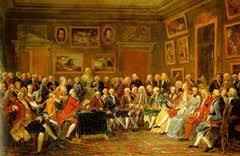
In the Salon of Madame Geoffrin in 1755
The Wednesday Night Salon is not unique, much as it pains us to say so. As Cleo Paskal OWN points out, the Greeks have been debating in public and private settings for 2,500 years.
We are justifiably proud that in 2008, Wednesday Night gave birth to a young sibling (to mix metaphors) in Vancouver under the expert guidance of Dr. Alexandra Tcheremenska-Greenhill OWN and her husband James. The West Wing edition , which has sadly been cancelled due to extensive demands on the time of Alexandra, the indefatigable entrepreneur, was a monthly event as lively as the original, but unique and distinct, as is appropriate for the Left Coast.
Then, in 2017, Marc Nicholson opened the 1880 in Singapore. Although the 1880 is a commercial undertaking, the concept, and particularly the introduction of ‘salon’ events, he attributes to growing up with the Wednesday Night Salon Why we are building 1880.
A fascinating piece that Anne Sophie Coleman OWN forwarded about the Cultural Salon of Dr. Alaa Al Aswany has inspired us to create this Page dedicated to Other Salons, Other Customs.
We suspect that some 150,000 years ago there was an elitist group of homo sapiens (probably no women) who gathered around the fire to debate the issues of the day: hunting grounds deteriorating thanks to the damn migrants/nomads; the efforts of one or another to take over the leadership of their community; the strange changes in the weather … not so different from today’s preoccupations. Maybe even the occasional criticism of the avant-garde graffiti in the caves in the next valley.
In October 2009, our dear friend Dartmouth Professor emeritus James Heffernan was researching Eleanor of Acquitaine and discovered the following: The twelfth-century Thibault Count of [Blois et] Champagne, in his capacity as advisor to Eleanor of Aquitaine, was said to have proposed that she consider summonyng to her castle a fayre seleccioun of worthie vassals and theyre laydies for discours on sundrie thyngs pertayning to her realm and sometime wittie converse besides, upon the firste Wednesdaie of ye month (ANNALS OF CHAMPAGNE: SECOND SERIES, ed. Philip Johnson (Oxford: Clarendon), Vol. 4, p. 223). Jim concludes “Though it is not known whether Eleanor acted on his advice, it seems to have had some very long range results.”
More recently: “The term salon is commonly associated with French literary and philosophical gatherings of the 17th century and 18th century, though the practice continues today in many cities around the world.” Traditionally, the great salonnières were women, but in 18th century Poland, the most famous salon was the Thursday Dinners of King Stanisław August Poniatowski.
We note with a certain glee that “There were also less well known ‘Wednesday Dinners’ (obiady środowe) which brought together educators, scientists and political activists.” That sounds familiar.
Stephanie Lalut brought to our attention a piece by Charles Dobson published in The Tyee in 2004 : Seven Great Ways to Build Community
Salons
Salons are small groups of people who gather together primarily for conversation. Since their origins in the Enlightenment of the 18th century and in 19th-century France, salons have been associated with social change. They bring to mind Margaret Mead’s often-quoted observation: “Never doubt that a small group of thoughtful, committed citizens can change the world: indeed it’s the only thing that ever has.”
In the past, well-connected aristocratic women would organize a salon, deciding who to invite and taking care to ensure a mix of the brightest and wittiest people. The salonières’ first job was to compose the salon for the best result. The right mix of people and perspectives was and still is necessary for a lively conversation.
A small number of people works best for salons, just as it does for other forms of community. Limit the size to ten people or less if you want everyone to be part of the same discussion. Invite people with different backgrounds who will enjoy one another’s company.
For more information see Salons: The Joy of Conversation, a guide to setting up and running a salon published by New Society. As this was published only in 2001, we cannot claim to have benefited from the findings, but are fascinated to learn that there is a National Salon Association that quickly drew over 20,000 members.
All of which would indicate that all around the world there are people who enjoy civil discourse and debate in a private setting with their peers. We intend to find out more about them.
The New York Times reminds us: “For centuries salons were a vital part of Iraqi intellectual life, places where people of different classes or sects met to discuss culture, literature or ideas. At one time Baghdad had more than 200 salons, about a quarter of them run by Jews”.
In recent years “during Saddam Hussein’s presidency, the salons dwindled away or went underground, as people objected to government control or feared the presence of government spies. In the sectarian violence that followed the 2003 American-led invasion, people were often afraid to meet in public. And now, “about a dozen salons that have sprung up around the city in the last two years as violence has dropped.” (February 2010)
The epicenter of wit and literary talent had to be the legendary daily gathering known as The Algonquin Round Table of 1920s New York. Sadly, it lasted only a decade, but better to have had 10 glorious years, than to have sputtered out after a much longer period. Also it’s interesting that one of the factors contributing to its disappearance was the intrusion of public spectators, bringing us to the conclusion that a certain amount of intimacy is a prerequisite for success.
In February 2016, Sandy Wolofsky forwarded this piece about a remarkable and long-lived salon in Paris. It’s a wonderful variation and much more elaborate than our Wednesday Nights, but with some similarities. We wish we could accommodate 60-70 people, but it would then be impossible to enforce the “one conversation at a time” rule on which David insists.
Jim Haynes – The man who has opened his home to strangers every Sunday for the past 37 years
“Basically, it’s a buffet dinner held in my home, to which I invite no one, everyone invites themselves. I invite the chef, and it’s always a different chef. Sometimes it’s Mexican, or Chinese, or French – it’s always different cuisine. About sixty or seventy people come. It takes place on Sunday night and lasts for three hours. About hundred and fifty thousand people have been to dinner so far.
Do you get a lot of expats coming?
Yes, I’d say that every week there’s a small percentage of people who live in Paris who come, maybe 20%. 30% of the crowd comes from Budapest, New York, Toronto, Istanbul…everywhere in the world.
Over time have you noticed a difference in the spirit of the people attending?
No. Human beings are human beings. I act as a kind of introducer. I try to make sure that everybody meets everyone, and that no one is sitting in a corner by themselves. I’m quite good at remembering names, so I’ll say, “Jean-Pierre, do you know Isabelle?” and “Isabelle, do you know Henry?” “Henry, do you know Paul?” Countless friendships, love affairs, marriages and projects have come from this.
If somebody wants to come to one of your Sunday Salons what should they do?
They should send me a message through my website www.jim-haynes.com.
How far into the future do you anticipate doing this?
Well, I’ve done them for 37 years, I’ll do them for another 37 years, and that’s enough.
Former Vancouver Mayor Sam Sullivan, who joined us at a Wednesday Night in July 2011, founded the Global Civic Policy Society which hosts the very successful Public Salons
For 10 Years Global Civic Founder Sam Sullivan hosted private salons over dinner with about 10 invited guests from a broad cross-section of the community. His friend and mentor Prof. Abraham Rogatnick was a frequent guest and just before he died he urged Sullivan to bring the benefits of the salon to a broader public. As a tribute to his friend Abraham, Sullivan decided to do just that. The Public Salon presents public policy ideas and promotes public discussion of them.
On the other hand, we have the infelicitous 2009 attempt by the Washington Post’s marketing people to create a pay-for-intimacy salon at the home of the publisher, Katharine Weymouth – a really bad idea. Fortunately, the plan was cancelled. But the Post didn’t stop trying: according to recent reports “Having taken a beating for trying to set up evening salons where reporters could mingle with corporate types who’d pay big money for the privilege, the Washington Post then attempted a more benign way to raise revenue: wine tastings—with reporters as guests.” Didn’t Like the Salon Idea? Have a Glass of Pinot Noir
The Lloyd House Wednesday Night Pot Luck Salon in Cincinnati
Meets Wednesdays at 5:45, EVERY Wednesday, 52 WEEKS/YEAR come hell or high water, as my mother used to say. We discuss politics, arts, and personal experiences. We welcome diversity of viewpoint and diversity of background … We are usually about 10 people of varied erudition and age. We like to talk politics, environmentalism, social issues, literature, the arts, and any blamed thing we want. Sometimes we have a special presenter. We emphasize good fellowship and civility always. Many similarities to our Wednesday Night Salon, including a number of the topics.
In Chicago, the Elgin Salon since 1998 has offered another, but nonetheless similar experience.
“Our inspiration was the concept of a neighborhood conversation salon promoted by the Utne Reader in the early 1990s. The gatherings we host aren’t much like the long-ago salons of Paris or New York, where authors, artistes, pundits and socialites would strut their stuff. There is nothing elitist about this salon. The gatherings probably most resemble encounters you may have had around campfires, over kitchen tables, in dorm rooms or at slumber parties, during times in your life when everyone you knew seemed eager to share visions and ideas.”
Mireille Silcoff, who wrote a great piece about Wednesday Night for the National Post, went on to start monthly salon meetings in Toronto in 2003. Her Salons had a Jewish focus. “I’ve never belonged to a synagogue. I didn’t intend to join one,” said Silcoff, 32. But she wanted an opportunity to do something Jewish with other Jews. She hosted the first salon meetings in her apartment. They were by-invitation-only, advertised by word of mouth. Within three months, Silcoff had a waiting list “a mile long,” mostly of 20ish and 30ish artists and media types, and the salon outgrew her home. It moved first to a hotel, then to the French restaurant. “You’re looking at people who would never go to a Jewish thing.” Participants talk about “Jewish topics” –– the use of counter-culture, the construct of the “cool Jew” –– within “a Jewish context,” Silcoff said. It’s not for meeting dates or making business contacts. The purpose is “to incorporate Jewishness into the everyday life of people.”
The Charlottetown Conversation Salon sets forth an objective that sounds similar to the Wednesday Night Salon:
“We try to recreate (in a contemporary and informal context) the energy and relevance of the Salons of previous eras… gatherings that had an important influence on social progress.
So we welcome people of all persuasions and disfavor the formation of ‘cliques.’ The only requirement for attendance is sincerity and an interest in expressing your views and insights while remaining appreciative of those of others.”
In what sounds like a creative approach to community dialogue, the University of North Carolina has introduced salons as a program of the Institute for the Arts and Humanities (IAH). They are “designed to connect UNC faculty with the broader community for intellectual exchange [and] to promote conversation between diverse constituencies. Each salon is hosted by a community member, who invites friends or colleagues to attend. The IAH invites interested faculty and guests talk over dinner.”
Arcade – a digital Salon, sponsored by the Division of Literatures, Cultures, and Languages of Stanford University
In the academic sense, a salon is a gathering of intellectuals who engage in thought provoking discussion with each other and with their social and political peers. Salons were common in 17th and 18th century France, and the ideas and philosophies exchanged then have been credited with spurring the Enlightenment.
The popularity of the salon waned in the succeeding centuries, but the increasingly social Internet era has inspired a group of humanities scholars to create a new and improved virtual incarnation of these intellectual get-togethers. This new digital salon, moderated by scholars from around the country is called “Arcade.”
Taking a cue from the social media trend, Arcade is designed to serve as a social and scholarly community for those with an interest in humanities research. The website, launched in the Fall of 2009, offers a range of opportunities for intellectual networking in an environment that is especially unique because content is curated by an editorial board comprised of academics representing a range of disciplines such as several literatures, Information Studies and Digital History.
Tucson, Arizona hosts the Wednesday Night Salons at Casa Libre … designed to be a forum for artistic discussion. As artists and writers, our creative processes often keep us isolated while we are in the process of creation. There are lots of opportunities for us to workshop our creations in an academic setting, but fewer opportunities to simply share our works in progress with fellow artists in a casual environment. The Salons give local writers and artists an opportunity to interact, discuss, network, and banter. They are an opportunity to share work with peers, and learn a little bit about an invited speaker’s creative process.
A December 2009 discovery: Friday Night Salon
When was the last time you had a genuine conversation–an experience not of mere self-assertion but of speaking and listening as though you had something both to offer and to receive? Our habits of language define us, but the pace of our lives is such that the simple gestures of listening carefully and speaking prudently are amazingly rare. The Friday Night Salon aims at being an alternative to the urban rush that denies the civilizing graces of community. We begin with good food and drink, then take our places in a circle for discussion about a variety of relevant, substantial topics. It’s a welcome way to end the Dallas workweek.
There is, of course, Salon, the e-zine (Salon.com), the [self-described] award-winning online news and entertainment Web site that combines original investigative stories, breaking news, provocative personal essays and highly respected criticism along with popular staff-written blogs about politics, technology and culture. But in its current incarnation, it is somewhat shrill. As an inspiration for Wednesday Night, it lags far behind many other sources.
Not to be overlooked is the more ambitious – and commercial – Salon Speakers started in Toronto and more recently expanded to Calgary with the addition of a new partner, Peter White (who has been a guest at Wednesday Night). “In Montreal we launched our series at Club 357 in 2008 with our co-director Deon Ramgoolam. We have also expanded our series in the United States with our first event held in Vero Beach, Florida in 2009. Our objective is the same in all these cities: to invite global thinkers and doers to address ‘the pressing issues of our times’…” Our quibble with this concept is that it sounds more like a revenue-generating conference (not that there is anything wrong with that) than a Salon.
One Comment on "Other Salons"
Hello from Los Angeles, CA.
I was doing some research for The PLATO Society of Los Angeles, inquiring about the EU’s relations with Russia, in particular, the Russian Clans. One click led to another and here we are.
Apparently we have some common interests. PLATO, https://www.theplatosociety.org/ seems to me, is ‘salon’-like, as salon-like as you’re going to find in LA-LA Land.
I don’t ‘represent’ anyone other than myself and I’m not asking for anything. Just wanted to say hello. The interent