Sudan/South Sudan: Conflict and governance September 2025-
Written by Diana Thebaud Nicholson // May 20, 2026 // Africa, Government & Governance, Sudan // Comments Off on Sudan/South Sudan: Conflict and governance September 2025-
Sudan has been caught in the grip of a devastating war since April 2023, when two generals who had joined forces to stop a transition to civilian rule fell out and turned on each other.
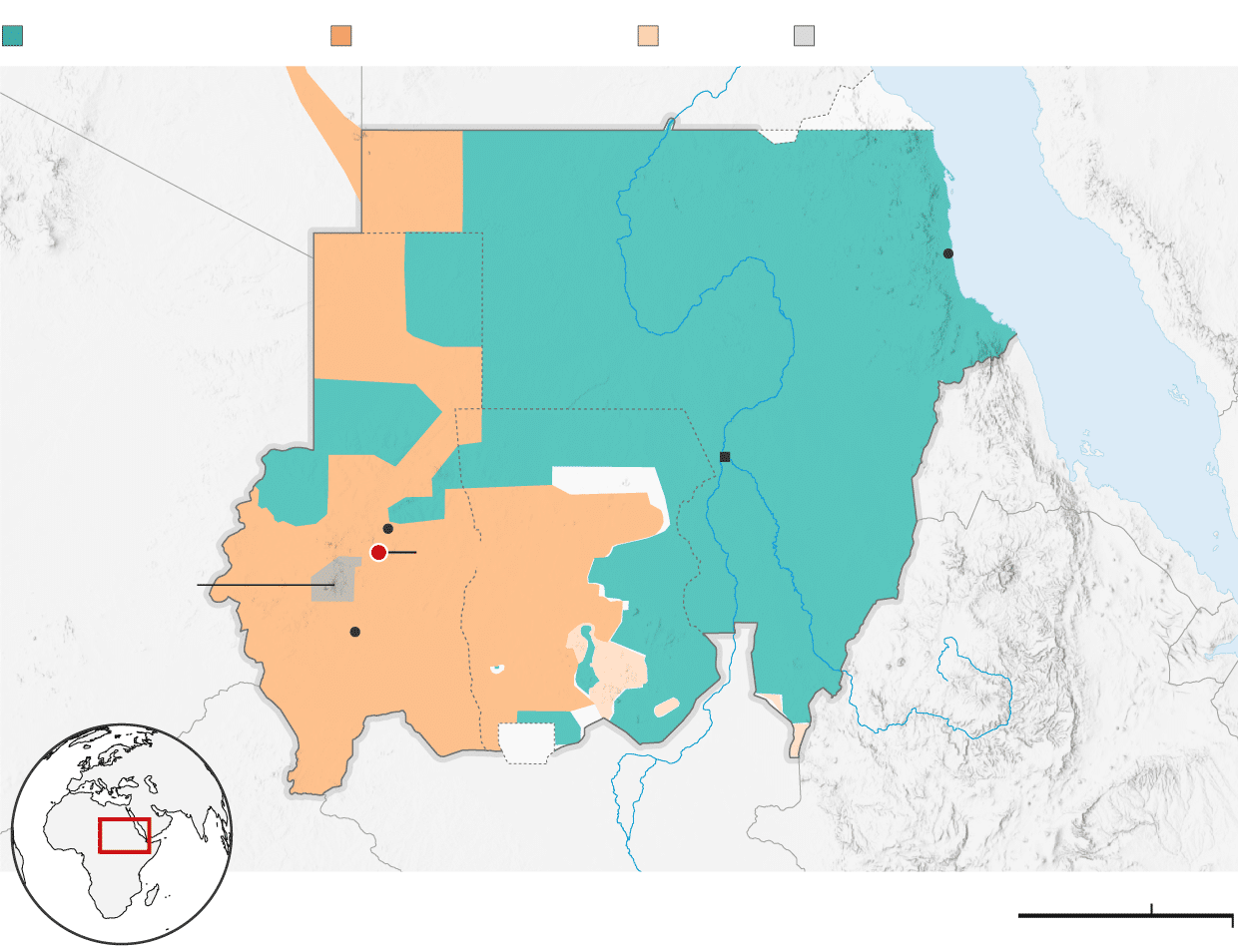
The RSF has been pitted against the Sudan Armed Forces (SAF) ever since, now controlling most of Darfur and neighbouring Khordofan, while the SAF controls the country’s north and east.
When the SAF recaptured Khartoum earlier this year, the RSF turned its attention to El Fasher more fully, the last SAF stronghold in Darfur.
20 May
Death in Darfur: 3 days of horror caught on camera
Sudanese paramilitary forces recorded themselves killing civilians while conquering the city of al-Fashir – as their commanders stood by. Using fighters’ videos and survivor accounts, this Reuters documentary reconstructs the violence.
Reuters documentary
16 May
Sudanese army captures key town near Ethiopian border from RSF
Sudan’s army says it retook a vital town in southeastern Blue Nile state, inflicting heavy losses on RSF personnel and military equipment.
(Al Jazeera) Blue Nile state has become a key flashpoint in the conflict due to its geography, serving as a gateway to central Sudan, and giving whoever controls it a greater chance of advancing into the country’s central regions.
The state also borders Ethiopia, which the Sudanese government accuses, alongside the United Arab Emirates, of backing the RSF. Both countries deny the allegations.
13 May
On Monday morning it was a busy South Sudan hospital. By Tuesday night it was a bombed-out shell
Exclusive: An 80-bed MSF facility was bombed, burned and looted as civil conflict grows. The Guardian visited to witness first-hand the impact of the ‘trend of violence’ against healthcare in the country
… Six days after its visit to assess the extent of the damage in Lankien, MSF announced the permanent closure of the hospital. It is the fourth hospital MSF has been forced to shut down in South Sudan since the beginning of 2025. In its statement, the organisation said the attack on its Lankien facility was “part of a wider and deeply worrying trend of violence against healthcare in South Sudan”. The closure came a year after MSF denounced the deliberate bombing of its hospital in Old Fangak, Jonglei, that killed seven people.
The UN estimates that, since December 2025, more than 304,000 people in Jonglei have been displaced by fighting between the South Sudan People’s Defence Forces (SSPDF), the government army loyal to President Salva Kiir, and the Sudan People’s Liberation Movement In Opposition (SPLM-IO), the opposition group led by the now-suspended vice-president, Riek Machar.
“Civilians are bearing the brunt of a spike in indiscriminate attacks, including aerial bombardments, deliberate killings, abductions and conflict-related sexual violence,” said the high commissioner for human rights, Volker Türk, in late February. He noted that on both sides, “troops have demonstrated a near total disregard for civilian protection”.
According to the UN humanitarian agency (Unocha), 33 health facilities have been either looted or destroyed in Jonglei, leaving 1.4 million people with no access to healthcare.
The UAE tries hard to keep its reputation spotless. But with the war in Sudan, how can it?
Nesrine Malik
(The Guardian) Outrage is mounting about the Gulf country’s complicity in Sudan’s catastrophic civil war – and it might be starting to hit them where it hurts
here are certain states whose reputations in the global community are tainted. For habitual violations of international law, they are shunned, boycotted or slammed with economic sanctions. Reading these words, perhaps you’re thinking of Russia, Israel, Iran or North Korea. But there is one country that is rarely considered an outlaw, even if its actions increasingly fit the bill.
The United Arab Emirates (UAE) is belatedly starting to draw some scrutiny over mounting evidence that it is backing the Rapid Support Forces (RSF) that have been terrorising Sudan for years. Since the beginning of the civil war in 2023, which was triggered by a contest for power between the RSF militia and the Sudanese army, the RSF has been accused of ethnic cleansing and sexual violence. A United Nations fact-finding mission concluded that its assault on non-Arab populations in the west of the country carried “the hallmarks of genocide”.
Last week, in quick succession, two blows landed. In the first, the human rights organisation FairSquare called on the UK’s Foreign Office to investigate Sheikh Mansour bin Zayed Al Nahyan, the deputy prime minister of the UAE and owner of Manchester City, and sanction him over his alleged role in the UAE government’s backing of the RSF.
The complaint, submitted to the UK government, stated that “there is an abundance of evidence from multiple credible sources, including the UN panel of experts on the Sudan, that the UAE has been providing weapons, ammunition and other supplies to the RSF since June 2023”.
15 April
(The World) Sudan
Sudan on Wednesday enters a fourth year of war that’s being called an “abandoned crisis,” as a new conflict in the Middle East throws into shadow the fighting that has forced 13 million people to flee their homes. The situation in the country has been described as the world’s largest humanitarian challenge, particularly in terms of displacement and hunger. There is no end in sight to the fighting between the military and the paramilitary group Rapid Support Forces, or RSF, which witnesses and aid groups say has laid waste to parts of the vast Darfur region. Growing evidence shows regional powers like the United Arab Emirates backing combatants behind the scenes. Attempts by the United States and regional powers, now distracted by the Iran war, have failed to establish a ceasefire. At least 59,000 people have been killed. At least 6,000 died over three days as the RSF rampaged through the Darfur outpost of el-Fasher in October, according to the United Nations. More than 11,000 people were missing over the course of the war, the Red Cross says. The war has pushed parts of Sudan into famine. The number of people with severe acute malnutrition, the most dangerous and deadly kind, is expected to increase to 800,000.
Another milestone for a bleak civil war
(GZERO media) Sudan marks a grim milestone today: three years of a civil war widely described as the world’s worst humanitarian crisis.
At least 59,000 people have been killed. There have been multiple accusations of genocide in Darfur. Fourteen million people – roughly a quarter of the population – have been forced from their homes, while 19 million face acute hunger. Now, the Iran war is driving up food and fuel prices in an already devastated economy.
And yet, there is still no end in sight to the fighting between the Sudanese army and its former ally, the paramilitary Rapid Support Forces (RSF). Drones have also expanded the battlefield, with those living far from the frontlines also facing threats – unmanned aerial vehicles have killed nearly 700 people so far in 2026, per the UN.
The conflict has grown more complicated due to murky foreign involvement. Three of the same countries that pushed for a humanitarian truce in November – the UAE, Saudi Arabia, and Egypt – along with Russia, have been accused of trying to shape the conflict through a mix of weapons transfers, financial and logistical support, and diplomatic backing.
Despite the international entanglement, the war in Sudan has drawn far less attention than the conflicts in Ukraine and, more recently, Iran.
9 January
Sudan: 1000 days of war deepen the world’s worst health and humanitarian crisis
(WHO) Today, the conflict in Sudan reaches its 1000th day, with over 20 million people requiring health assistance and 21 million desperately needing food.
Nearly three years of continuous violence, severe access constraints, and reduced funding have turned Sudan into the worst humanitarian crisis globally. An estimated 33.7 million people will need humanitarian aid this year.
The health system has been severely damaged by ongoing fighting, increasingly deadly attacks on health care, mass displacement, lack of essential medical supplies, and shortages of health personnel and funding. Despite sustained efforts by WHO and partners to restore and revive health services across the country, more than one third of health facilities (37%) remain non-functional, depriving millions of people of essential and lifesaving health services.
Since the start of the conflict in April 2023, WHO has verified 201 attacks on health care, resulting in 1858 deaths and 490 injuries. These attacks, which violate international humanitarian law, undermine access to lifesaving care and put health care workers, patients and caregivers at grave risk.
“One thousand days of conflict in Sudan have driven the health system to the brink of collapse. Under the strain of disease, hunger and a lack of access to basic services, people face a devastating situation,” said WHO Representative in Sudan, Dr Shible Sahbani. “WHO is doing what we can, where we can, and we know we are saving lives and rebuilding the health system. Despite the challenges, we are also working on recovery of the health system.”
The level of displacement is unprecedented. An estimated 13.6 million people are currently displaced, making Sudan the largest displacement crisis in the world. Fueled by poor living conditions, overcrowding in displacement sites, disrupted health and water, sanitation and hygiene services, and a breakdown of routine immunization, disease outbreaks are spreading, compounding the crisis. WHO is currently supporting the response to outbreaks of cholera, dengue, malaria, and measles, with cholera being reported from all 18 states, dengue from 14 states, and malaria from 16 states. Access to preventive and curative care, including for the management of chronic conditions and severe malnutrition, remains limited.
11 March
Sudan’s devastating war rages on as regional rivalries deepen
Yet the Iran crisis may push Gulf rivals to set aside their differences and revive stalled diplomacy on Sudan.
(Al Jazeera) Sudan’s civil war will soon enter its fourth year, with no end in sight. The conflict has drawn in other regional actors, who support and sustain the war by backing Sudan’s belligerents. This risks precipitating a much wider fallout in the region, with severe consequences in and out of Sudan. Sudanese civilians are paying the price.
Militarily, momentum has swung back and forth between the Sudanese army and the paramilitary Rapid Support Forces (RSF). Today, the front line largely runs along west-central Kordofan, with no decisive breakthrough in sight. As the war edges towards its fourth year, the conflict is steadily regionalising into the Horn of Africa and the Red Sea, making any settlement that much harder to reach.
… Sudan’s geostrategic position helps explain why outside powers remain deeply invested. The country sits at the crossroads of the Red Sea, the Horn of Africa, the Sahel and North Africa. For some regional powers, the war is not only about Sudan itself, but about their own national security interests as well as the projection of influence in a rapidly changing and contested regional order.
8-9 March
(The World) The United Nations Mission in South Sudan said Monday that it would not comply with a government order to shut down its base in Akobo, an opposition stronghold near the Ethiopian border where tens of thousands of refugees have fled. On Friday, the South Sudanese army ordered UN peacekeepers, as well as NGOs and civilians, to vacate the town ahead of a planned assault. But the mission refused to leave and said it would provide “a protective presence for civilians” in the town, adding that the safety and security of its personnel “must be fully respected at all times.” The UN Mission said it was engaging “intensively with national, state and local stakeholders” regarding this order. “Any military operations in and around Akobo gravely endanger the safety and security of civilians,” said mission chief Anita Kiki Gbeho. The South Sudanese government has been fighting opposition forces since a 2018 peace deal broke down about a year ago. A dramatic escalation took place in December 2025, when opposition forces seized several government outposts in northern Jonglei. A government counter-offensive repelled their forces a month later and displaced over 280,000 people. Tens of thousands have sought refuge in Akobo, where a small contingent of UN peacekeepers is stationed
Thousands of civilians in South Sudan flee opposition-held town after army’s evacuation order
2025
29 October
Sudan war takes a turn as paramilitary force captures Darfur, threatening to split the country
Sudan’s brutal two-year war has entered a new, dangerous phase. The paramilitary Rapid Support Forces this week seized control of the entire Darfur region, after ousting the rival Sudanese army from its last stronghold there. The fighting for control of Sudan has killed over 40,000 people and created the world’s worst humanitarian crisis, with over 14 million displaced. The capture of el-Fasher, the provincial capital of North Darfur, by the powerful Arab-led force raises fears that Africa’s third-largest nation may split again, nearly 15 years after the oil-rich South Sudan gained independence following years of civil war. The RSF had fought the Sudanese army in Khartoum and controlled the capital for two years before retreating early this year after a devastating battle that left it in ruins. The paramilitary regrouped in Darfur and made new local alliances that strengthened its hold over parts of neighboring Kordofan region. This year, RSF was once again able to carry out attacks, including drone strikes, on Khartoum and eastern Sudan, where the army commander is based. With the takeover of el-Fasher on Monday, the RSF has seized control of Darfur, threatening to split the country or expand its military campaign once again toward the country’s center.
27 October
Massacres under way in Darfur after militia captures besieged city, reports say
Widespread reports of massacres and other atrocities are emerging from Darfur after a powerful Sudanese militia captured most of the famine-stricken city of El Fasher at the end of an 18-month siege.
… El Fasher, capital of North Darfur, was the last remaining city outside the RSF’s control in the Darfur region of western Sudan. The RSF built a 57-kilometre earthen wall around the entire city this year, cutting off its food supply. As the siege tightened, it attacked the city with drone strikes and artillery shelling, and reportedly executed civilians who tried to leave or enter the city. …
Human rights groups have been predicting for many months that the paramilitary Rapid Support Forces (RSF) would begin executing non-Arab civilians if it captured the city where an estimated 260,000 people have been under siege. On Monday, evidence of the massacres was triggering alarm around the world.
Much of the evidence was contained in social-media videos posted online by the perpetrators themselves. The videos of brutal close-range executions by RSF gunmen were unverified, but were taken seriously by Sudan analysts, United Nations experts and foreign diplomats, all of whom expressed deep concern.
UPDATED 27 October
2 October
What to know about the war in Sudan
The conflict is in its third year, with the latest ceasefire talks going nowhere. Meanwhile, aid is falling far short of what’s needed
The catastrophic conflict in Sudan, now into its third year, is one of the deadliest in the world today.
The war has triggered the world’s biggest humanitarian crisis. With famine already under way in some parts of the country, and with 25 million Sudanese people in need of food aid, it is considered the world’s worst hunger crisis. It also the world’s biggest displacement crisis, forcing 12 million people to flee their homes. And it has huge geopolitical implications, drawing in fighters and weapons from across Africa and the Middle East.
The fighting erupted in Sudan on April 15, 2023, after weeks of tensions and feuding between the Sudanese Armed Forces and a powerful paramilitary group, the Rapid Support Forces.
16 October
(GZERO media) El Fasher, Sudan, has been declared “uninhabitable” after 549 days under siege by RSF forces. Ninety percent of homes are destroyed, food and water are nearly gone, and acute malnutrition affects children and mothers. Constant bombardment, hospital attacks, and communication blackouts have left 250,000 civilians trapped and barely surviving inside the paramilitary force’s blockade of the city.
Thousands trapped in El Fasher siege on ‘edge of survival’, says report
The city – the Sudanese army’s last stronghold in the west of the country – has withstood more than 500 days of attacks by paramilitary RSF
(The Guardian) The besieged Sudanese city of El Fasher has been declared “uninhabitable” with new data indicating most homes are destroyed and critical levels of malnourishment among people trapped there.
The stark assessment comes as the city endures constant artillery and drone attacks, shoehorning its 250,000 starving people into a shrinking urban enclave.
For 549 days El Fasher has been surrounded by fighters from the paramilitary Rapid Support Forces (RSF), who have prevented all humanitarian access entering the city as it attempts to seize the army’s last stronghold in west Sudan.
Testimonies from households encompassing almost 900 people who recently fled the city – countless others have been abducted and killed by the RSF for trying to escape – confirm a population “pushed to the edge of survival”.
6 October
Sudan’s civil war has faded from headlines, but monitors say it’s the largest humanitarian crisis in the world
Those trapped in besieged city of El Fasher face either intense shelling or risk of execution on road out
(CBC) The number of Sudanese risking their lives to make it out of the besieged city of El Fasher in North Darfur is rising as the paramilitary Rapid Support Forces (RSF) intensify their attacks on the regional capital, according to aid agencies, including Medecins Sans Frontieres (MSF).
“The numbers are still increasing [from] mid August up to now,” said Romain Madjissembaye, the MSF project manager in Tawila. Located about 60 kilometres west of El Fasher, it has become a major hub for the displaced.
He said that last week, they saw around 90 people who arrived in critical condition. “A lot of them are malnourished and they are facing executions on the road, some gunshots,” Madjissembaye told CBC News via a Zoom interview.
An estimated 260,000 civilians, including 130,000 children remain trapped in El Fasher according to UN agencies. Surrounded by RSF militias on three sides, the city has now endured over 500 days of siege, cut off from food, medicine or a safe exit.
Some media reports suggest people are having to eat animal feed to survive.
MSF pulled out of El Fasher — one of the few remaining places not under RSF control in Darfur — in August 2024, just a few months after the siege began in May.
 Surging Nile waters inundate Egypt and Sudan, revive dispute over Ethiopian mega-dam
Late-season flooding hits villages in Egypt’s Nile Delta
Egypt blames Ethiopia’s ‘reckless unilateral’ management of its grand dam
Ethiopia rejects charge, says regulated water releases reduced impact
IOM says about 1,200 Sudanese families displaced
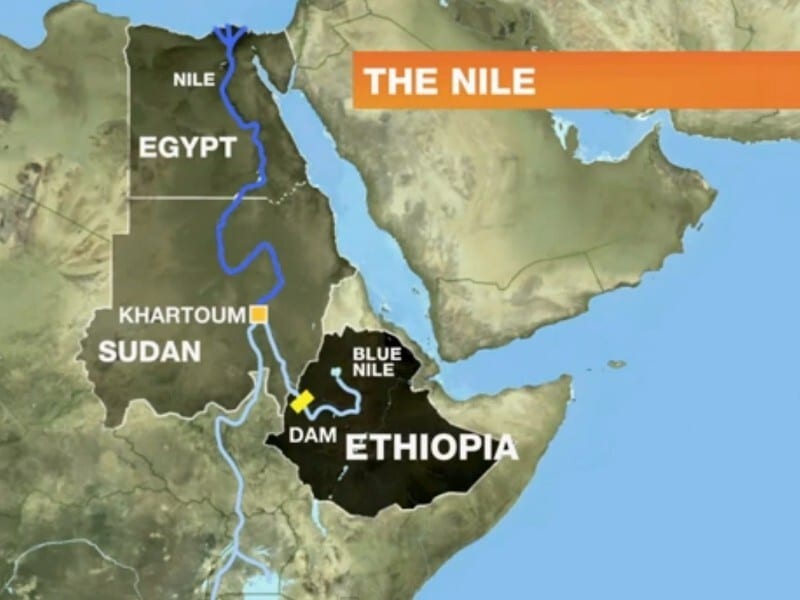
(Reuters) – Rising Nile waters inundated homes and fields in northern Egypt over the weekend, forcing residents to move by boat and intensifying a war of words between Cairo and Addis Ababa over whether Ethiopia’s giant Nile dam has worsened seasonal floods.
In the Nile Delta village of Dalhamo, in Menoufia Governorate, some 50 km (31 miles) northwest of Cairo, men paddled wooden boats through narrow lanes where water lapped at the walls of their homes.
Ethiopia’s giant Nile dam, the Grand Ethiopian Renaissance Dam (GERD), is Africa’s largest hydroelectric project, intended to double Ethiopia’s electricity output and provide power to millions through a clean energy source. Though a source of national pride and a key to the country’s economic transformation, the dam’s construction has caused significant, prolonged tension and opposition from downstream countries, Egypt and Sudan, who fear negative impacts on their water supplies. It is Africa’s largest hydroelectric project, one of the biggest in the world [and] is situated on the Blue Nile River, about 30 kilometers upstream from the border with Sudan.
… The Nile has long been affected by seasonal flooding due to monsoon rainfall in the Ethiopian Highlands that usually peaks in July and August. But this year a late-season surge has pushed north from Ethiopia, through Sudan, and into Egypt.
In Sudan, the U.N. migration agency said floods in Bahri, Khartoum state, displaced about 1,200 families last week and destroyed homes, compounding an 18-month war that has crippled the country’s response.
24 November 2023
The Ethiopian Dam and its Effects on Egypt and Sudan
As much as GERD will benefit Ethiopia, the dam seemingly poses significant threats and costs to Egypt and might have mixed effects on Sudan. All three countries share the same water that flows from the Blue Nile, and to understand the conflict over GERD it is crucial to know the legal instruments governing it. In 1959, Egypt and Sudan signed a bilateral treaty which allocated 55.5 billion cubic meters (BCM) to Egypt, or 66% of the total, and 18.5 BCM to Sudan, or 22% of the total, with 18.5 BCM accounted for through evaporation and seepage, which is 10% of the total. The treaty acknowledges that Egypt and Sudan have acquired rights to Nile waters and that they have the right to veto all construction projects on the Nile and its tributaries, which means Ethiopia does not have Nile rights nor license to build its dam.
2 October
Deaths, disappearances and forced recruitment: refugees recount horrors of relentless war in Sudan
Refugees who left Darfur and Khartoum for South Sudan say they feared being targeted by both sides in conflict
(The Guardian) The war in Sudan war has created what the UN has described as one of the worst humanitarian crises of the 21st century. More than 150,000 people have been killed, more than 14 million displaced, and a larger number still are in need of humanitarian aid.
The fighting, which is fuelled by foreign powers, has raged in the absence of a concerted international effort to end it.
The war has been marked by widespread brutality and atrocities, with multiple accounts of sexual violence as a weapon of war, and the discovery of hundreds of mass graves. Both warring parties have been accused of committing war crimes, and the RSF has been accused of committing genocide, ethnic cleansing and crimes against humanity.
A report by the UN’s Office of the High Commissioner for Human Rights said at least 3,384 civilians were killed between January and June, mostly in the Darfur region, an RSF stronghold comprising five states in Sudan’s west and south. The region has been a centre of intense fighting in recent months, as the group pushes to maintain its territorial dominance there after losing the Sudanese capital, Khartoum, to the army in March.
The latest focus of the battle is El Fasher, the last remaining major city in Darfur controlled by the army. An estimated 260,000 people have been trapped for 16 months by an RSF siege that has cut off humanitarian assistance and caused starvation.
… The RSF emerged from Arab Janjaweed militias that were co-opted by the regime of former president Omar al-Bashir from 2003 to help suppress an insurgency by non-Arab groups in Darfur.
Researchers at the Avaaz advocacy group say the RSF and its allies are continuing to ethnically target darker-skinned and non-Arab people. For their part, the army and its allies view Darfurians who did not flee areas formerly under RSF control as collaborators or sympathisers. The army is also suspicious about people from communities who formed part of the non-Arab resistance to the government and the Janjaweed in the 2000s.
24 September
‘We will never, ever escape’: inside the ever-tightening siege of the Sudanese city of El Fasher
For 500 days, 260,000 people have been trapped by the paramilitary RSF. While political progress stalls, those who attempt escape are killed and those who remain inside are starving. Experts believe the city will soon fall and the endgame has begun