Trump and Washington D.C.
Written by Diana Thebaud Nicholson // August 1, 2026 // Arts and culture, Cities, U.S. // No comments
12 June
Fact-Checking Trump’s Justifications for His Makeover of Washington
President Trump has made false or exaggerated claims of a Civil War-era push for a triumphal arch, hundreds of millions spent on repairs on the Reflecting Pool, and an absence of working fountains.
A hulking 250-foot triumphal arch embellished in gold. A reflecting pool now tinted dark blue. Decorative fountains scattered across the capital that cost tens of millions of dollars to renovate.
President Trump, who has long leaned into his roots as a real estate developer, has started renovation projects around Washington as he looks to remake the capital in his own image. To address criticisms of ballooning costs and preservation concerns, Mr. Trump has insisted that the initiatives have historic precedent and represent his prowess at deal-making and instinct to take action.
1 August
Why 70 Percent of Trump’s Mind Is on Renovations
Forget the Iran war and tariffs. Maggie Haberman explains on “The Ezra Klein Show” why Trump is so fixated on remodeling the White House and building an arch. (Transcript)
(NYT) It’s a legacy thing. But I always think of legacy with him different than the way we usually use the word “legacy.” It’s not: What am I leaving behind for the world? It’s what am I leaving behind so the world can’t kick me off the world or deplatform me or take my name off buildings in Manhattan or take away my Bronx leased golf course or debank me? It’s: What can I do that cannot be taken away? Yeah: how can I create monuments to myself? …
31 July
DOJ drops Reflecting Pool charge, citing ‘botched’ work and contradicting Trump
Trump claims vandals deliberately damaged the pool, but prosecutors dropping charges against David Hearn say a contractor probably rushed installation.
26 July
I’ve visited the Smithsonian hundreds of times. Warnings aren’t needed.
By Philip Kennicott
An executive order from President Donald Trump may be laughable, but it shouldn’t be laughed off.
AI Overview
The Trump administration has ordered that signs be placed outside the Smithsonian National Museum of American History that claim its exhibits are divisive. The executive order follows a critical White House report from July 4. Critics argue this undermines the institution’s integrity and the National Park Service’s responsibilities. The move is seen as part of a broader effort to rewrite American history.
The warning signs the Trump administration has ordered placed along walkways outside the Smithsonian National Museum of American History will attest visually at least one truth: The institution is under siege. On Friday, President Donald Trump signed an executive order, “Restoring Trust in the Smithsonian Institution,” that requires the National Park Service to place signs near the history museum that “notify visitors that the Museum exhibits should be renovated” consistent with a highly critical report issued by the White House on July 4 claiming that the museum was divisive and misleading in its presentation of American history.
White House report accuses Smithsonian museum of ‘extreme political activism’
The 162-page report on the National Museum of American History marks an escalation of President Donald Trump’s criticism of the Smithsonian museums.
25 July
Whitewashing (audio)
Heather Cox Richardson: Letters from an American
It turns out Trump has not abandoned his plan to paint the massive gray granite Eisenhower executive office building white.
As Philip Tennecott reported in the Washington Post yesterday, more than two dozen experts have sued to stop the plan, saying paint could irreversibly damage the stone and would be a taxpayer’s nightmare, as the building would have to be repaired and repainted regularly. But on Monday, Deputy Assistant to the President Heather Martin filed a declaration saying the White House Office of Administration was beginning preparations for the paint job.
As Kennecott points out, the administration is using the case to give the president the ability to erase the nation’s physical culture, its man-made, natural, and cultural wonders. The administration is arguing that the General Services Administration, or GSA, the agency that normally handles maintenance of federal buildings, has ceded control of the building to the White House Office of Administration. The GSA follows the requirements of the National Historic Preservation Act and the National Environmental Policy Act, laws that require extensive reviews and input from experts and the public. Those laws do not apply to the White House Office of Administration. Greg Werkheiser of Cultural Heritage Partners, one of the organizations that sued to stop Trump from painting the Eisenhower Executive Office Building, told Kennecott, the precedent is potentially devastating. Anytime the president takes a personal interest in a project, he can simply pluck it out of an agency that is subject to review and put it in his own shop.
That change would not be limited to buildings, Kennecott explains. It could be used, for example, to rush a pipeline through pristine wilderness. A White House official told Kennecott that the White House conducts necessary reviews and that taking over for the GSA allows the White House to more efficiently and economically manage the project.
The Lincoln Memorial reflecting pool would like a word. Kennecott also calls out the administration’s proposed major rule change in the National Historical Preservation Act, or NHPA. Trump installed a loyalist as vice chair of the Advisory Council on Historic Preservation. On Friday, July 17th, the chair proposed dramatic revisions to Section 106 of the NHPA.
This is the section of the 60-year-old law that requires federal agencies to take into account what their actions will do to historic properties and places. This is the requirement that gives the public, as well as local, state, and tribal governments, a voice in the changes to historic and cultural sites.
Brent Leggs is the Chief Executive Officer of the National Trust for Historic Preservation, a privately funded non-profit organization founded by Congress in 1949 to support historic preservation. He warned that the ACHP’s proposed changes to Section 106 will eviscerate the preservation of our shared civic and cultural heritage in the United States. If they are implemented, federal agencies will no longer be required to avoid or minimize damage to our nation’s historic sites and landscapes or seek public input on federal projects that would impact historic places.
Trump officials vote to rewrite historic preservation rules, in boon for arch
The president’s planned triumphal arch has been bound up in reviews under the law, known as Section 106.
(WaPo) Trump officials on Friday voted to rewrite federal rules intended to protect historic sites, sending the plan to the White House for further review.
The Advisory Council on Historic Preservation, a federal agency that oversees preservation reviews and advises the president and Congress, said it was moving forward with changes to a federally required process that governs changes to landmarks such as the National Mall, sites that are significant to Indigenous tribes and other properties eligible for listing on the National Register of Historic Places. The process currently applies to any construction projects that are on federal land or receive federal funding, as well as private projects that require any type of federal approval.
If codified into law, the new rules would make it easier for President Donald Trump to pursue his controversial construction projects — such as building his planned triumphal arch — and could eliminate the need for public input on other major federal projects.
The ACHP is dominated by Trump appointees, leaving little doubt the proposal would pass.
The proposed rules “will now move to the interagency review process” overseen by the White House’s Office of Management and Budget, Ashley Fry, an ACHP official, wrote in an email. Once it clears that review, the proposal will be opened for public comment before being finalized.
Under the current rules, federal agencies must undertake a multistep Section 106 review assessing the potential effects of construction projects and soliciting public input, among other requirements.
The changes would allow federal agencies to approve construction projects that would impact historical sites without the previous requirement to seek the agreement of affected states, tribes and other interested parties. The proposal also would allow an agency to unilaterally decide whether or not it’s in the public interest to allow public participation in the review process.
24 July
Trump’s plan to paint the Eisenhower is about more than damaging stone
The administration’s proposal risks harming both the historic building and the system of reviews that protects structures like it.
By Philip Kennicott
AI Overview
Architect Stephen Kelley and preservation experts oppose Trump’s plan to paint the Eisenhower Executive Office Building white, arguing it could damage the stone and set a dangerous precedent. The lawsuit alleges Trump’s administration bypasses historic and environmental reviews, risking irreversible harm. Critics say this move reflects power dynamics and disempowers experts and the public.
The potential legal precedent set by Trump’s renovation plans.
How painting could permanently damage the Eisenhower Building.
The broader implications for public involvement in preservation decisions.
(WaPo) On Friday, President Donald Trump signed an executive order, “Restoring Trust in the Smithsonian Institution,” that requires the National Park Service to place signs near the history museum that “notify visitors that the Museum exhibits should be renovated” consistent with a highly critical report issued by the White House on July 4 claiming that the museum was divisive and misleading in its presentation of American history.
White House report accuses Smithsonian museum of ‘extreme political activism’
The 162-page report on the National Museum of American History marks an escalation of President Donald Trump’s criticism of the Smithsonian museums.
19 July
Inside Trump’s Rush Job to Build His Arch
If the president gets his way, new rules would lower the bar for building monuments in Washington.
By Janay Kingsberry
(The Atlantic) Building a new monument in Washington, D.C., is supposed to take time—a slow procedural grind of plans drafted, designs revised, studies conducted, and preservationists, historians, tribes, and architects consulted all before work crews ever break ground. The idea is to preserve the carefully choreographed symbolism of the federal city. That is not the approach favored by Donald Trump, who wants to leave his mark on the city’s symbolic core before he leaves office.
Right now, his proposal for the United States Triumphal Arch—a 250-foot granite structure planned for Memorial Circle, on the western bank of the Potomac River, across from the Lincoln Memorial—is trotting through that process, including consideration under a historic-preservation requirement known as Section 106. But as the proposal proceeds, I learned this week that an independent federal agency that Trump has quietly reshaped is contemplating changes to the rules that govern Section 106. The move could potentially speed up not only Trump’s plans for Washington but also federal projects affecting historic places nationwide, while shrinking the amount of scrutiny they receive.
A July 17 email and draft amendments to regulations I obtained show that the Advisory Council on Historic Preservation will consider a vote to revise the rules governing Section 106.
… Sara Bronin, a law professor at the George Washington University Law School who previously chaired the Advisory Council on Historic Preservation…argues that it would narrow the types of historic properties protected, weaken consultation with tribal nations, dramatically curtail public participation, and exempt large categories of federally backed state and local projects from Section 106 altogether. “If adopted, these regulations will be challenged in court, and I doubt they will survive judicial scrutiny,”.
16 July
How the Smithsonian Could Fall
A president cracking down on museums is unusual—but so are the museums.
(The Atlantic) The Trump administration wants to control the Smithsonian, but it won’t be so easy. When experts talk about the institution’s relationship to the federal government, the world’s largest museum complex can start to sound like a bureaucratic outcast. The Office of Legal Counsel has called the Smithsonian a “very unusual entity” and a “historical and legal anomaly.” A law-journal article describes it as “Quasi-Government at the Private Border.” One attorney told me that it resides in the legal “netherworld.”
… In a 162-page report published on July 4, the White House’s Domestic Policy Council claimed that the National Museum of American History has “failed to tell America’s story and adheres to a radical, activist ideology”; it also criticized the museum’s leaders for not being patriotic enough. By far the longest public White House censure of a Smithsonian museum yet, it arrived after more than a year of pressure and suggests that the Trump administration has designs to exert greater influence on the institution’s work.
… Since the president returned to office with history as one of his newfound hobbyhorses, several institutions have already gone through Donald Trump–led transformations. For all the White House has said about the Smithsonian, though, actual changes to the sprawling system have been relatively limited. As the institution faces refreshed threats, its ability to hold the line will be tested again. Legally, conceptually, and even practically, “America’s Attic” can be hard to grasp—whether you’re an administration official trying to meddle with its exhibits or a tourist trying to find the Air and Space Museum and ending up next door at the Hirshhorn Museum. The institution’s quirks could end up saving it. …
4 July
A Huge Escalation in Trump’s Smithsonian Meddling
A White House report details what the administration wants to change in museums—and suggests that a crackdown could be coming.
… Titled “Saving America’s Story,” the report is filled with…accusations against one of the marquee museums in Washington, D.C., ramping up criticism after more than a year in which repeated threats and demands aimed at the Smithsonian Institution seemed to be going mostly nowhere.
Trump Is Building a White House Helipad. He Sought No Approvals.
(NYT) … Past presidents have involved Congress and review panels in changes to the White House grounds, though Mr. Trump has asserted that he has the right to undertake major construction projects, such as a new 90,000-square-foot ballroom, without congressional approval. That project is currently the subject of litigation.
A White House spokesman said in an email that “operational upgrades to the White House grounds, such as the helipad installation, do not require commission reviews.”
Work on the helipad — which will be 100 feet in diameter and feature a presidential seal — started last month, shortly after a makeshift stadium built to host an Ultimate Fighting Championship fight significantly damaged the South Lawn.
… Mr. Trump is also trying to build a helipad at his Mar-a-Lago resort in Palm Beach, Fla. But that project is moving much more slowly than the one at the White House.
The Mar-a-Lago project has been the subject of local historic preservation commission review, multiple public hearings, negotiations with town lawyers and votes by the Town Council. …
The helipad would significantly reshape the South Lawn, which has historically hosted events and ceremonies, including the annual White House Easter Egg Roll.
8 July
Unfolding disaster in DC as water turns brown at Trump’s ‘completely renovated’ park
(Raw Story) A park that President Donald Trump bragged that he had “renovated” for $16 million suddenly had its water turn a murky brown this week, the latest in a string of his D.C. beautification “disasters.”
Letters from an American June 27, 2026
Heather Cox Richardson
Observers are noting that the reflecting pool fiasco, in which Trump created the idea there was an emergency, ignored experts, bypassed normal procedures to give a wildly inflated contract to a crony, bragged about his success, ignored the problems, claimed his enemies had sabotaged him, and finally stationed troops around the landmark he had turned into a swamp, represents the Trump administration perfectly.
But a report by Michael Scherer of The Atlantic about Trump’s remodeling of the West Colonnade is perhaps an even better representation of the Trump presidency. In March, Trump tore up the light brown Tennessee flagstone that paved the walkway in the West Colonnade that connects the White House residence to the Oval Office and replaced it with polished black African granite carved in Italy. When a reporter asked Trump who was paying for the remodeling, Trump answered: “Paid for by me.”
But, as Scherer discovered, that was a lie.
26 June
‘Rush Project at Request of POTUS’
Money once used for crucial national-park repairs is now financing Trump’s redecorating projects.
By Michael Scherer
(The Atlantic) … Budget documents from the National Park Service that I obtained show that the walkway replacement cost taxpayers $689,232, and is part of a $1.3 million project that included repairing adjacent stone and masonry and providing new hardware for nearby doors. A year earlier, in a separate “Rush project at request of POTUS,” the Park Service spent $347,503 to remove and replace the stucco on the colonnade wall, a project that cleared the way for Trump to affix gold frames and plaques mocking some of his predecessors.
Taxpayer spending on projects in the National Capital Region has increased 92 percent over the past year, according to the budget documents. The windfall draws on revolving maintenance accounts and more than $100 million in fees collected almost entirely from national parks elsewhere. Trump has ordered the refurbishment of fountains, the lining of the Reflecting Pool, and a $1.6 million Fourth of July fireworks display on the National Mall. He has requested billions more from lawmakers, who thus far have refused. “I’m so proud of Washington, D.C.,” Trump said Wednesday during a meeting in the Oval Office with the secretary-general of NATO. “It’s become one of the hottest cities in the world.”
20 June
Trump claims Reflecting Pool was vandalized and says law enforcement is investigating
(CNN) Trump’s Reflecting Pool renovations were initially estimated to cost $1.8 million. The price tag on the project is now up to $14.7 million, according to a contract summary of the Interior Department’s award to Atlantic Industrial Coatings.
The president, in his Friday night post, touted his beautification projects in DC, a primary focus of his second term in office, and slammed Democrats for not fixing the pool sooner.
 19 June
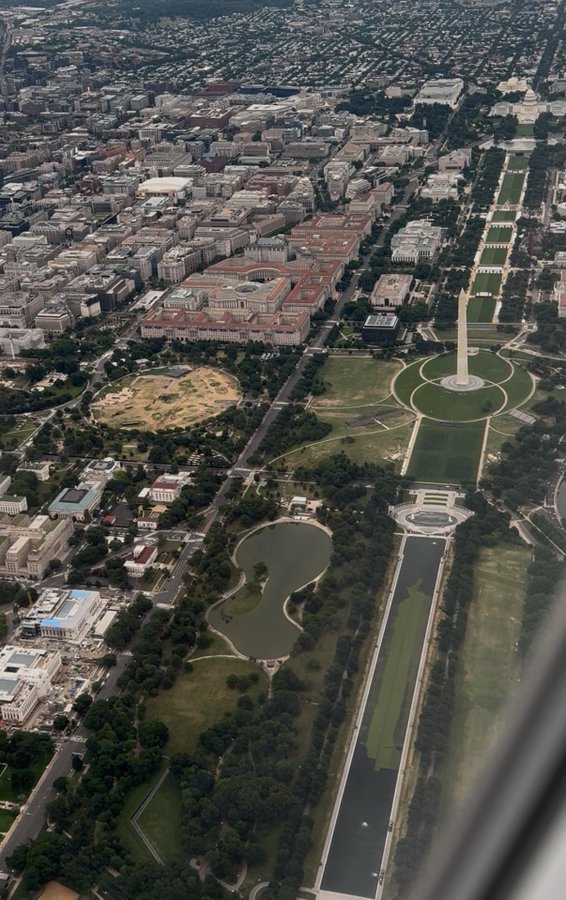
Stunning aerial photo reveals breadth of Trump’s DC destruction
(AlterNet) There are 15 days until the 250th birthday of the United States of America. Trump said that he wanted Washington D.C. to be “beautiful” for the birthday. But, as the photo reveals, some of Trump’s projects look a little rough.
Once a ceremonial sweep of green near the White House, the “front lawn,” or Ellipse, was taken over for Trump’s blood sport on his birthday. Critics have argued that these branding campaigns are diminishing the dignity of the White House. But they’re also tearing up the actual White House complex.
The aerial photo Brooks shared goes beyond the green Reflecting Pool to show just how bad the damage was to the White House lawn due to the UFC event. The walking paths and stunning grass north of the fountain have given way to a flattened pad of dirt.
Over the past year, Trump has made extravagant promises in his effort to remake public space in his own image, sometimes literally, as one D.C. resident complained in a Slate piece. The result remains the same and has served as a metaphor for his presidency, one columnist wrote. The city has been left with less civic grace and more wear and tear as residents absorb the aftershocks.
16 June
Trump said no taxpayer money would be spent on the ballroom. A contractor’s invoices show otherwise.
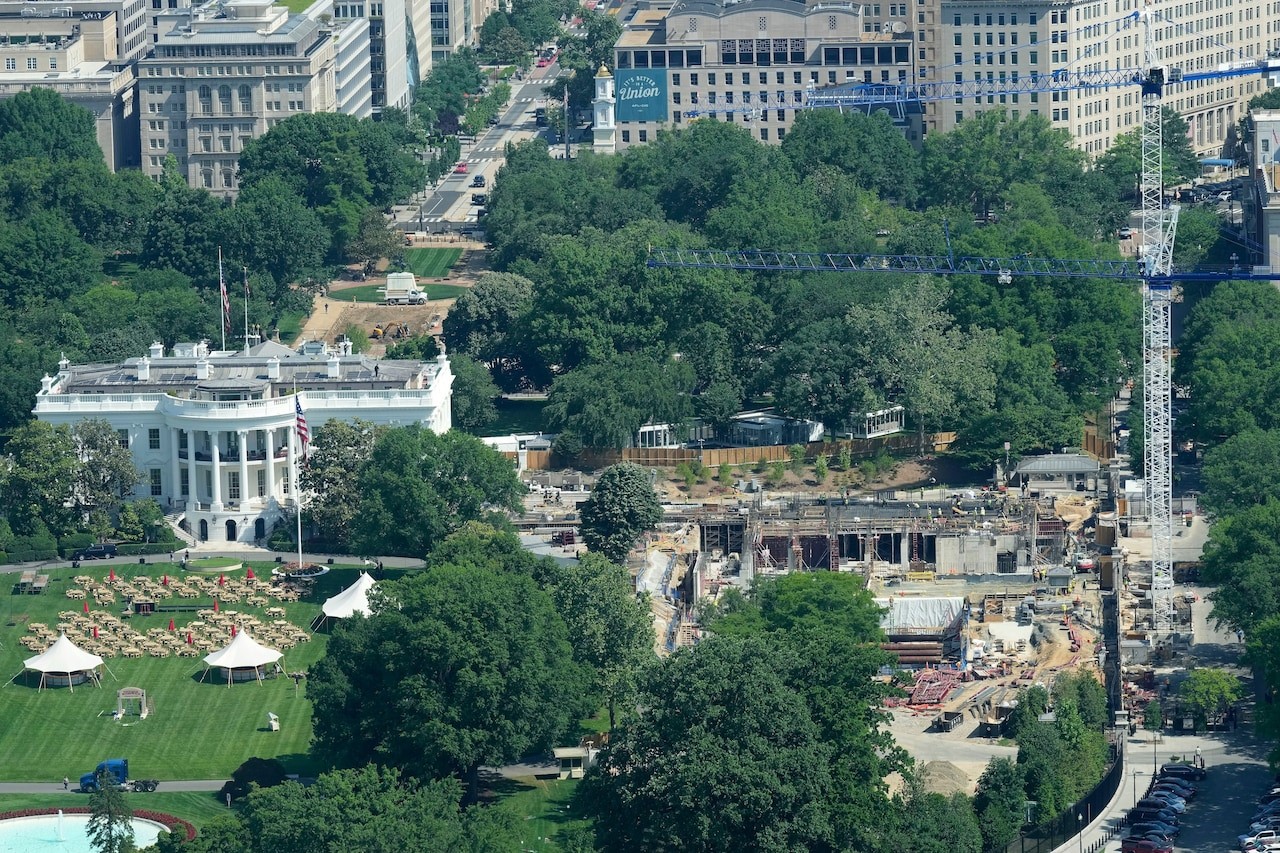 An internal cost estimate in March by the project’s contractor put its cost at $600 million, with half coming from tax dollars.
(WaPo) Five months after the demolition of the White House’s East Wing, President Donald Trump claimed that the project to construct a massive ballroom and a bunker in its place would cost up to $400 million and that private donors would pay for all of it.
“This is taxpayer-free. We have no taxpayer putting up 10 cents,” Trump told reporters in the Oval Office on March 31, describing the project as including bomb shelters and major medical facilities.
But a detailed project summary prepared for the White House by the contractor more than three weeks before Trump’s comments estimated the total construction cost at $600 million — with more than half coming from taxpayers, according to a copy of the contractor estimate obtained by The Washington Post.
When the White House first announced the plan to build a ballroom on July 31, 2025, it said in a news release that contributions from Trump and “other patriot donors” would cover the cost of the project, which it said would be $200 million. The White House added that the “United States Secret Service will provide the necessary security enhancements and modifications.” There was no mention of an underground military bunker.
Heather Cox Richardson Letters from an American June 15, 2026
President Donald J. Trump’s remaking of Washington, D.C., to reflect his personalized approach to power rather than the American people and their government has become a little too on-the-nose over the past week.
After weeks of hyping the idea that he would restore the Reflecting Pool by the Lincoln Memorial to “SPECTACULAR” condition after it had been “destroyed by Barack Hussein Obama and Sleepy Joe Biden,” Trump today reposted an article from the right-wing site Breitbart, titled: “‘Thank You President Trump’: Reflecting Pool in D.C. Wows After Trump Renovations.”
In fact, as Kinnia Cheuk of Politico reported today, the renovations Trump said would cost $1.5 million appear from federal contracting records to have cost almost $16 million, and the pool is now fouled with green algae.
Lawmakers Warn Trump Officials Not to Pursue Arch Project Without Congress
In a letter to Interior Secretary Doug Burgum and national parks officials, several Democrats and a Senate independent said that members of the administration could face fines and even criminal prosecution.
West Potomac Park recently underwent a major seawall restoration project. President Donald Trump’s administration is considering the Washington park as a potential site for the planned National Garden of American Heroes
D.C. groups sue over Trump’s planned ‘Garden of American Heroes’
Six local preservation and cultural heritage organizations said work must stop on the statue garden in West Potomac Park until Congress authorizes the project.
Trump officials have already begun to commission statues and secure funding to build the garden on a large field that is an extension of the National Mall, and the president and his deputies have repeatedly said the project is moving forward.
Culture wars aren’t the only problem with two new Smithsonian museums
The Women’s History and Latino Museums should be built on the Energy Department headquarters site.
(WaPo) … Yet the Mall ought to be preserved from massive structures that block important views and occupy much-needed public space. The Mall was originally conceived by engineer Pierre L’Enfant in 1791 as the grand axial backbone of a city built for future greatness. The McMillan Plan of 1901-02 rescued the Mall from a century of encroachment. These achievements should not be casually cast aside. The Mall is, as Congress formally recognized in 2003, “a substantially completed work of civic art.”
The storied institution wanted to jam them into two awkwardly shaped parcels of land on the National Mall: one close to the Washington Monument, the other by the Tidal Basin. The assumption appears to be that the Mall is the only honorific location in Washington.
Smithsonian Identifies Two Optimal Sites for New Museums
Final Designations Pending Legislative Action
Heather Cox Richardson Letters from an American May 23, 2026
President Donald J. Trump’s proposed triumphal arch would sit at a rotary on the Virginia side of the Arlington Memorial Bridge between Arlington National Cemetery and the Lincoln Memorial in Washington, D.C.
The proposed arch obscures the Lincoln Memorial, built to honor the president who steered the country safely through the Civil War, but perfectly frames Arlington House, the mansion built by enslaved Americans and once owned by Confederate General Robert E. Lee. The arch does not frame the nation’s honored dead, but frames instead the home of the man who led the armies of the Confederacy that killed them.
10 April
Officials Release Design for 250-Foot Arch in Washington, as Trump Seeks Another Imprint
The president has proposed the arch, which would rise on a Washington roundabout across from the Lincoln Memorial, as a way to celebrate America’s 250th anniversary.
(NYT) Mr. Trump displayed models of the proposed arch at a White House fund-raising dinner in October for another of his projects to reshape Washington’s map, the planned $400 million White House ballroom. The president said the angel on top of the models was Lady Liberty.
… Mr. Trump has taken a number of actions to remake Washington in his image and remodel the White House, including covering the Oval Office in gold and paving the grass of the Rose Garden. The president is also planning a National Garden of American Heroes with 250 statues.
But the most dramatic step was his sudden demolition last fall of the White House’s East Wing to make way for his planned 90,000-square-foot ballroom. The unveiling of the arch design on Friday came as Democrats rebuked the president over the acceptance of foreign donations for the ballroom. A federal judge has ordered that project halted unless approved by Congress, and the Trump administration has appealed the ruling.
23 March
A group of Vietnam War veterans has sued to stop the arch’s construction as well, citing congressional authority and arguing the arch would obstruct the view between the Lincoln Memorial and Arlington National Cemetery.
Trump Is Digging Up Washington. Can Lawsuits Stop the Bulldozers?
As the president develops plans to fundamentally alter the White House, the Kennedy Center and other sites, federal lawsuits are beginning to catch up.
(NYT) It took an act of Congress to create the John F. Kennedy Performing Arts Center. It may take two federal lawsuits to stop President Trump from remaking it with his name attached.
There is no guarantee that either lawsuit will succeed, nor three others challenging Mr. Trump’s plans to build a championship-level golf course in the nation’s capital, erect a 250-foot arch next to the Arlington National Cemetery and append a ballroom to the White House.
In his second term, President Trump has returned to his identity as a real estate developer, teeing up pet construction projects and monuments to himself among, and sometimes on top of, other historic sites in Washington’s crowded landscape.
Now, legal challenges are mounting to try to stop the bulldozers, forcing federal judges to reckon with novel questions about the president’s power to unilaterally control the federal government’s real estate portfolio. It will be for the judiciary to decide what authority Congress holds over federal land and institutions and whether the president can invite allies instead of taxpayers to finance his projects.
2025
23 December
‘He’s a Maximalist’: Inside Trump’s Gilded Oval Office
The New York Times has recreated the president’s office in 3-D, using hundreds of photos taken in October
… Mr. Trump spends a great deal of his public and private time in the Oval Office. Here, he fields phone calls from allies, hosts hourslong staff meetings and takes questions from reporters while cameras roll.
It’s not unusual for presidents to decorate the space to their own tastes. They often choose art or items meant to evoke meaning and a historical connection to past political eras.
But in his second term, Mr. Trump has placed a connection to his lavish decorating style above all else. His tastes veer toward the gilded, triumphal style of Louis XIV, a theme that shows up in his own properties.
Mr. Trump has regularly added to or swapped out items in the Oval, according to Karoline Leavitt, the White House press secretary. Some of Mr. Trump’s changes go beyond the decorative — he has installed a red button on his desk that lets him instantly order a Diet Coke.
Most objects on the walls are from the White House archive. But a few things, including gold angel statuettes placed above two of the doorways, were brought in from Mar-a-Lago, his estate in Palm Beach, Fla.