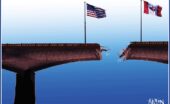
FIFA World Cup 2026 and aftermath
Written by Diana Thebaud Nicholson // August 10, 2026 // Canada, Mexico, Sports, U.S. // Comments Off on FIFA World Cup 2026 and aftermath

The World Cup that restored my faith in America
Not even Trumpian meddling could dampen a nationwide celebration.
Will Leitch
(WaPo Opinion) … The tournament brushed Trump off like lint from its shoulder. This was the most successful World Cup in just about every way — financially, athletically, competitively, perhaps most of all sociologically — and it basically turned into a five-week party in America’s streets. The World Cup was pure pleasure, but it was more than that: It restored my faith in people. I’m so sad it’s over.
…this was also a World Cup that reminded us what America is at its best. Heading into the tournament, much was made about the Trump administration’s inhospitality; in November, then-Homeland Security Secretary Kristi Noem said she hoped fans “would come and enjoy our country, and then they would go home. And go home in a timely manner.” But that was not how this World Cup went down. The joy of the competition was how welcoming Americans were, not just to visitors who came to watch the games but also to all the different people and perspectives the tournament brought out from within.
Watch parties — joyous celebrations of diversity, community and collective warmth — became the norm in cities across the country. You could watch Morocco play among their fans at a restaurant in Queens, or Bosnia with an expat community in St. Louis, or Congo among former refugees in Silver Spring, Maryland. Or you could just watch whatever team, wherever you wanted, with whoever happened to be nearby: The games were always on, and there was always someone you didn’t know next to you, ready to become a friend.
10 August
Trump Defends Infantino as UEFA-Led Schism With FIFA Deepens
(Bloomberg) “FIFA would be making a terrible mistake if, for any reason, they even considered replacing President Gianni Infantino,” Trump said in a Truth Social post late Monday. He praised Infantino for presiding over “the most successful World Cup, by four times, ever presented.”
Uefa, Concacaf and AFC push for Infantino to quit and discuss rival competitions
Confederations write open letter damning Fifa president
Concacaf president Montagliani seen as top contender
(The Guardian) In a dramatic escalation of the war that has threatened to tear football apart since details emerged of the Fifa president’s failed Football Forward Enterprise (FFE) scheme, the three governing bodies accused Infantino of “trust broken through deception” and condemned his failure to acknowledge that the proposal should not have been unilaterally launched.
7 August
The Guardian view on Gianni Infantino: in the interests of the game he professes to love, he should go
(Editorial) … [I]t was a serious abuse of power to negotiate a deal mortgaging the World Cup’s future to speculators seeking to extract even more wealth from it. From the dubious award of the 2022 World Cup to Qatar, to Fifa’s suspension of inconvenient red cards, Mr Infantino is used to provoking and ignoring controversies. This one must come with consequences.
With haughty presumption, the statement from Mr Infantino’s Rabat bunker said the organisation “will no longer tolerate any attacks on its integrity, good governance and due process”. The chutzpah is almost impressive. But really, dream on. Unless Fifa’s president resigns, is forced out, or is ousted via an election next March, the global game is in danger of descending into an ugly civil war – all because of one man’s attempt to sell off the family silver in unprecedented fashion….
2-6 August
Uefa maintains World Cup boycott still stands despite Fifa’s backing for Infantino
(The Guardian) The latest damning intervention from European football’s governing body came as criticism of Infantino continued to rain in from several angles. The global players’ union, Fifpro, condemned “a profound abuse of presidential power” while the South American confederation Conmebol, usually a strong Infantino ally, was moved to chastise “repeated unilateral actions taken without resorting to dialogue”.
It is Uefa’s continued stance, though, that may damage Infantino most severely. In a statement it said Fifa’s public backing of Infantino on Wednesday night “changes nothing” and explained it was not convinced repeats of the past nine days’ crisis will not occur. Last week Uefa’s 55 member associations agreed to boycott Fifa tournaments if Infantino did not withdraw his privately funded Fifa Forward Enterprise (FFE) scheme and, although the plan was scrapped last Friday, it said the terms necessary to avert the boycott have not been met.
Uefa made it abundantly clear in its statement on Saturday that it has lost confidence in Gianni Infantino’s presidency. That position holds. Yesterday’s announcement that some people employed by the Fifa president (and whose careers depend on his favour) agree with him changes nothing.”
… Uefa remains hopeful it can exploit divisions within Fifa’s leadership despite the Infantino-led show of unity following Wednesday’s meeting of some of its management board in Rabat.
There were several notable absentees, however, and the Guardian has been told Arsène Wenger declined an invitation to travel to Morocco in his capacity as Fifa’s chief of global development because of a desire to distance himself from Infantino. The former Arsenal manager had launched a scathing attack on the World Cup sell-off plans, saying it was “absolutely necessary and beyond question” that they were scrapped.
FIFA says leadership fully supports President Infantino
(Reuters) – FIFA said on Wednesday its leadership reaffirmed “full support” for President Gianni Infantino at a crisis meeting with senior officials of world soccer’s governing body in Morocco.
‘I don’t have confidence’ in FIFA president Gianni Infantino, Carney says“[FIFA] have their own procedures for making those determinations but certainly I don’t have confidence in Mr. Infantino after this point, given what transpired and given the nature of what transpired,” Carney said at a news conference on Wednesday.
Pressure on Gianni Infantino increases as Uefa members prepare to oppose re-election
European nations to withdraw letters of support for Fifa president
Appetite to ensure Infantino is quickly removed from post
Gianni Infantino’s reign is in severe peril after the collapse of his privately backed scheme to sell off chunks of the World Cup.
(The Guardian) Now a groundswell of national governing bodies are discussing the formal withdrawal of their support for Infantino in a bid to hasten his resignation, with announcements likely in the coming days.
earlier
Gianni Infantino could face leadership challenge as Fifa council members rebel
Council wants to trigger emergency general meeting
Members demand review of Balogun decision
The Fifa council is not due to meet until November with the rebels attempting to move quickly to force an EGM, where Infantino would be asked to explain himself. A refusal to commission an external review into Balogun would lead to more active attempts to oust Infantino, with alternative presidential candidates already being sounded out.
Uefa and Concacaf both issued further statements condemning Infantino and calling for a thorough review of Fifa’s governance on Saturday, but it is unclear if they have sufficient support from the rest of the world to oust him.
The Confederation of African Football and the South American Conmebol remain fully behind Infantino, while the Qatar Football Association issued a statement yesterday backing him to stay as president.
Of the 37 council members 14 are from Europe and North America so support from Asia will be required to put real pressure on Infantino.
Qatar’s stance has definitely ruled out a presidential bid from Paris Saint-Germain’s president, Nasser Al-Khelaifi, and much will depend on whether Victor Montagliani, the Canadian who is president of Concacaf, has the appetite to take on Infantino.
1 August
Fifa scraps proposal to sell off stakes in World Cup after widespread backlash
Gianni Infantino issues statement on controversial plan
‘This proposal will not proceed,’ confirms Fifa president
(The Guardian) Gianni Infantino’s proposal to sell chunks of the World Cup to private investors has sensationally collapsed, with the Fifa president admitting the project “has created divisions of a nature that are no longer in the interest of the objective”, amid widespread anger globally.
The plan had caused ructions within football around the world, leading Uefa to threaten a boycott of future Fifa tournaments if it was not shelved. Other confederations had also come out in opposition while one of Infantino’s senior advisors, Carlos Cordeiro, resigned on Friday in protest at the scheme. The Fifa chief operating officer, Kevin Lamour, had also aimed a scathing rebuke at Infantino’s “serious lack of respect” in seeking to force it through with minimal consultation.
… Attention will now turn to Infantino’s future given the scale of the internal revolt within Fifa and the severe hit his standing has taken elsewhere.
31 July
Gianni Infantino, Fifa and the week that rocked the football world
Ultimately doomed plan for sale of commercial rights to World Cup caused chaos with Uefa, AFC and Concacaf leading the opposition
Infantino dealt another blow as Asian confederation rejects plan
(MSN) FIFA’s controversial plan to sell stakes in a World Cup company has been dealt what appears to be a fatal blow after the Asian Football Confederation (AFC) joined UEFA and CONCACAF in rejecting it.
Gianni Infantino’s future as FIFA president now appears uncertain too, with the AFC statement also highlighting “fundamental weaknesses in FIFA’s consultation and decision-making processes that must now be addressed”.
The Press Association understands the 41 nations that make up CONCACAF, the confederation for North and Central America plus the Caribbean, are losing – or have lost – confidence in Infantino, while UEFA says it will boycott FIFA competitions until the plan is dropped.
The Swiss said the plans to create a new company to run the World Cup and FIFA’s other competitions would require a majority of FIFA’s 211 member associations. Collective opposition from AFC’s 47 members, added to CONCACAF’s 41 – of which 35 are FIFA members – and UEFA’s 55, would mean 137 now stand against it.
30 July
European nations vow FIFA World Cup boycott over Infantino private equity plan, CONCACAF joins in opposition
(AP) … Later Thursday, the 41-member Confederation of North, Central American and Caribbean Association Football (CONCACAF) met and announced it rejected Infantino’s plan.
European nations vow FIFA World Cup boycott over Infantino private equity plan as opposition spreads
(AP) — European nations agreed Thursday to boycott the World Cup and all other FIFA competitions to protest Gianni Infantino’s plan to sell stakes in soccer’s biggest tournament to private equity investors. The North American soccer body rejected his plan later the same day.
“UEFA and its national associations will not participate in FIFA competitions,” the European soccer body said after an urgent online meeting of its 55 member nations.
29 July
European soccer officials eye Qatari sports executive to challenge Infantino
Anger over FIFA’s plan to sell stakes in the World Cup has pushed European soccer leaders to rally behind a potential challenger: Paris Saint-Germain boss Nasser al-Khelaifi.
(Politico) Al-Khelaifi is the president of Paris Saint-Germain in France, runs the European Football Clubs umbrella group for the continent’s teams and is chair of the massive beIN Media empire.
…[gas-rich Gulf monarchy Qatar] hosted the 2022 FIFA World Cup as the culmination of a journey toward becoming a sports powerhouse sustained by deep investment.
As European soccer’s most influential business executive, al-Khelaifi is an intriguing candidate for the top job at FIFA. Backed by Qatar’s vast wealth, he has overseen a period of unprecedented success for Paris Saint-Germain, which has become Europe’s top soccer team. Al-Khelaifi stepped in to steady the club umbrella group, then called the European Clubs Association, in April 2021, when a breakaway plot by 12 top European clubs to create a “super league” threatened to blow up the continent’s soccer establishment.
27-28 July
FIFA plan for Kushner-backed $20 billion operation to run World Cup meets fury from Europe’s UEFA
(AP) — FIFA President Gianni Infantino’s plan to create a $20 billion company running the World Cup with private investors including the Kushner family was announced Tuesday — and immediately attacked by European soccer body UEFA.
Infantino’s plans to form a commercial subsidiary, which would be called FIFA Forward Enterprise (FFE), running competitions like the World Cup and Club World Cup was first reported by The Times of London.
FIFA said in a statement FFE would raise up to $4.2 billion later this year to help fund development programs “based on an initial equity valuation of $20 billion by carefully selecting long-term investors who will purchase minority, non-controlling interests.”
FIFA is working with J.P. Morgan while intended investors include Thrive Eternal launched by Joshua Kushner, whose brother Jared Kushner is a son-in-law of U.S. President Donald Trump.
Fifa president Gianni Infantino called to appear before Congress over Trump ties
Democrat Jamie Raskin pushes Fifa to release records of contact with Trump, administration and family business
(The Guardian) Jamie Raskin, the top Democrat on the House judiciary committee, has launched an investigation into Fifa president Gianni Infantino, seeking documents that would detail the ties between soccer’s governing body and Donald Trump and his administration.
In a Sunday letter, Raskin wrote to Infantino and called for Fifa to provide any documents and communications related to gifts, payments or benefits provided to Trump and his associates, as well as the visitor logs for Fifa’s office space in Trump Tower, which it acquired last year. The committee also requested that Infantino sit for a transcribed interview.
Infantino’s relationship with Trump came under scrutiny in the lead-up to this summer’s World Cup. In December, at the World Cup draw in Washington, Trump was awarded a newly created “Fifa peace prize” at the Kennedy Center, where renovations were allegedly “rushed” on the administration’s orders to prepare for the event. Fifa opened its office in Trump Tower in midtown Manhattan last July. …
18 July
Infantino’s Faustian bargain with Trump has stained football’s biggest stage
Nathán Goldberg Crenier
The Fifa president sought influence with the US leader. Instead, Fifa’s president has entangled football in politics and wounded the game’s credibility
Canada’s World Cup Window: Where Policy Meets Momentum
By Anil Wasif
(Policy) A week after powerhouse Spain beat powerhouse Argentina to win the 2026 World Cup final in New Jersey, of all places, Canadians are still processing our own place in a sport that has suddenly vaulted to the forefront of the national imagination.
… As Abacus Data’s David Coletto reported in the days following the final, soccer is now Canada’s second-favourite sport to watch or play, jumping ahead of baseball into the slot right behind hockey.
“In just two months, the share of Canadian adults with at least some interest in soccer rose six points, from 48% in May to 54% following the FIFA World Cup,” writes Coletto in his analysis. “That represents nearly two million additional Canadians and brings the total adult audience interested in soccer to almost 18 million people.” …
The difference between a golden summer and a golden generation is what a federation, a league, and a public do in the 10 years after everyone stops honking.
In April, the Carney government’s federal economic update pledged $660 million over five years to a sport system its own commission called broken, with $110 million for youth participation. And the cornerstone is now a live procurement. Canada Soccer has issued a formal request for proposals for a national training centre, priced at $250 to $300 million, with submissions due July 31 and a site and capital partner chosen this fall.
Canada is the only major soccer nation in the western hemisphere without such a facility. Against it, $9.8 million is secured and FIFA’s legacy contribution remains undetermined. The gap between the drawing and the building is where the quarterfinal will be won or lost, a financing decision that lands this fall, not in 2029.
The second paving stone is cheaper, a system that lets the best teenagers train together. Danilo Veselinovic, the federation’s new 24-year-old technical director, has proposed a national residency for roughly 30 of the country’s best 15-to-17-year-olds, modelled on France’s Clairefontaine, at about $3 million a year. It is still unfunded. It should be the easiest “yes” in Canadian sport.
The country has already run the experiment. Tennis Canada opened a Montreal residency in 2007 with roughly 50 teenagers at a time. It produced Andreescu, Auger-Aliassime, Shapovalov, and Raonic. Own the Podium concentrated $120 million before Vancouver 2010 and produced 14 golds.
All of it is administration — the unglamorous conversion of a moment into a system — and soccer, the most played game in the country, is the only major Canadian sport never to receive it. …
2026 FIFA World Cup
The men’s FIFA World Cup is coming to Canada for the first time this summer, as this country co-hosts the 2026 tournament with the United States and Mexico.
Between June 11 and July 19, 2026, 48 teams will play 104 games in the World Cup’s largest edition yet. Thirteen of those games will be hosted in Toronto and Vancouver.
The Fédération Internationale de Football Association (FIFA) is an international self-regulatory governing body of association football, beach soccer, and futsal. It was founded on 21 May 1904 to oversee international competition among the national associations of Belgium, Denmark, France, Germany, the Netherlands, Spain, Sweden, and Switzerland. Headquartered in Zurich, Switzerland, its membership now comprises 211 national associations.
Who should win the World Cup?
It’s a better question than “Who will win?” It tells you what the tournament is for
(The Economist) For players and fans, even whole countries, winning the World Cup is a secular rapture. One team and nation will experience that euphoria at the climax of this year’s competition, which begins on June 11th. A lot of ink and airtime will be expended on predicting who the champions will be. But a better question than who will win the World Cup is: who should win? Answer that, and you know whom to back when your home team is knocked out. To do so, you first have to grasp the tournament’s true purpose.
The World Cup is a branch of international relations. It is an expression of power by the hosts—this year America, Canada and Mexico—and a form of soft diplomacy. The draw can throw up grudge matches that are benign alternatives to war (such as, in 2022, Iran v America) and pair nations which ordinarily have little to do with one another (this time, for example, Cape Verde v Saudi Arabia). It helps supporters everywhere see what they have in common, starting with a shared devotion to watching 22 men chase a ball.
But for enthusiasts, the newsy headlines—about overpriced tickets, alleged corruption or sports-washing autocrats—are not the real story. The World Cup is only superficially a pageant for the powerful; underneath it is a tacit conspiracy against them. For a month or so every four years, football nuts around the globe sneakily tune in to games on the job, knock off early to binge more matches and let the children stay up for late kick-offs. No overlord, whether company boss or authoritarian ruler, can forbid this pleasure. …
Above all, the World Cup is a quadrennial festival of hope. Fans hope for an injury-time miracle, the salvation of an offside flag and a distraction from humdrum woes. They hope decades of failure will at last be redeemed, and so that history needn’t be destiny. Teams can embody hope for a different future, like the Argentina side led by Diego Maradona that prevailed in 1986, not long after its military dictatorship ended. Shock victories by underdogs give hope that the meek may indeed inherit the Earth.
‘Mexico 86’ – A World Cup comedy – one of The Best Movies and TV Shows Coming to Netflix in June
(NYT) Just in time for the 2026 edition of the FIFA World Cup, Netflix is debuting a film about the 1986 tournament, which helped inspire and unite Mexico in the wake of a devastating earthquake the year before. Diego Luna plays Martín de la Torre, an ambitious bureaucrat who takes the lead on Mexico’s underdog bid to to host the World Cup, wheeling and dealing — and lying and cheating — to beat out the U.S.A. and Canada. The director and co-writer Gabriel Ripstein (in collaboration with the screenwriter Daniel Krauze) fictionalizes the true story of Mexico’s triumph while satirizing the corruption and the excesses of government officials and business magnates.
4 July

Canada’s World Cup journey ends with 3-0 loss to Morocco in second knockout match
Canada’s World Cup adventure is officially over.
(Globe & Mail) The tournament co-hosts fell to a 3-0 defeat to Morocco in Houston on Saturday, with the reigning African champions moving on to the quarter-finals as a result.
The Canadian men’s national team gave a good account of itself in defeat, driving much of the play in the first half, but was unable to make it count.
Morocco regrouped after halftime, scoring twice through Azzedine Ounahi with Soufiane Rahimi adding a third goal to push its world-record unbeaten run to 34 matches.
Ranked seventh globally, the Moroccans are attempting to return to the semi-finals for the second straight tournament.
They move on to play the winner of France-Paraguay in Boston on Thursday,
19 July
Spain win World Cup after Ferran Torres breaks 10-man Argentina’s resistance
It was the triumph of an idea, an identity. Of an unshakable and patient faith. And when it was over, Spain’s new generation having emulated the one from the 2010 World Cup, all of those legendary names, there was simply delirium for them.
FIFA Crops Trump Out Of World Cup Photo—White House Adds Him Back In
Pictures shared to FIFA’s official social media accounts following the World Cup final, depicting the Spanish team holding the trophy on stage at MetLife Stadium, appear carefully cropped to exclude Trump, who stood near the team while they celebrated.
A photo the Spanish team posted on Instagram immediately after the match also does not include Trump, nor does a 20-slide post from later Sunday night that shows the team celebrating.
But on Monday afternoon, the White House shared six pictures from the final on social media, all of which include Trump—in two of which he is the only person in focus—while only two of the pictures include the Spanish team.
Trump’s presentation of the trophy was described by some commentators as awkward, as Infantino apparently attempted to guide Trump away from the team as they lifted the trophy and confetti launched from cannons.
FIFA appeared to crop out President Donald Trump and FIFA President Gianni Infantino from pictures shared to social media celebrating Spain’s World Cup victory over Argentina—but the White House shared a series of pictures Monday afternoon that all prominently feature the president.
Donald Trump and Gianni Infantino booed before US president attempts to crash Spain celebrations
US president watches Spain v Argentina match
Trump arrived at the stadium on Marine One, with the president’s helicopter first flying over the stadium about 45 minutes before kick-off. He sat in a glassed-in section of luxury seats for the match, along with Infantino. Other dignitaries and former players sat nearby, including Spain’s king, Felipe VI, Canada’s prime minister, Mark Carney, and Mexico’s president, Claudia Sheinbaum. …after Trump presented Spain with the World Cup trophy, he attempted to stand with the team at the side of the podium as they celebrated before Infantino quietly ushered him away.
Hits, misses and Muppets: the star-studded World Cup half-time show nobody asked for
It zipped along, cramming in Shakira, Madonna and Coldplay, but football fans may not be convinced of need for this mid-match spectacle
10 July
FIFA’s permanent US power base
(Politico) …the global soccer governing body will keep its Miami headquarters open, as it expands its presence in the Americas in the lead-up to future events across the region.
The strategy marks a significant shift in how FIFA has approached major tournaments. Rather than relying on a local organizing structure that dissolves after the final whistle, officials say the organization intends to retain the institutional knowledge assembled in South Florida and deploy it for the next wave of competitions.
“The whole idea was to bring 50 people from Zurich, who have the necessary experience and breadth who’ve done other World Cups and they became the nucleus of Miami and they hired people,” a senior FIFA advisor said earlier this year. “That’s a model that we intend to use for future World Cups.”
The Miami team will pivot toward the next slate of marquee events. Brazil will host the World Cup next year, and FIFA will help manage the soccer portion of the LA28 Olympics. And while Spain, Portugal and Morocco will serve as the primary hosts of the 2030 men’s World Cup, Uruguay, Argentina and Paraguay will each stage one opening match to commemorate the tournament’s centennial.
Just a year later, the United States is expected to host the 2031 women’s World Cup, giving FIFA another major event on American soil.
9 July
Mbappe lifts France to World Cup semifinals after missing penalty vs Morocco
Opinion: Trump’s own goal at World Cup feels like poetic justice
By intervening in the beautiful game, the U.S. president turned soccer fans across the globe into fervent Belgium supporters.
8 July
2026 World Cup Odds: France, Argentina Favored For Finals Rematch
On July 19, after 103 matches have been played, only two teams will remain standing at the 2026 FIFA World Cup.
Those two nations, each chasing soccer immortality, will meet at New York New Jersey Stadium in what is expected to be one of the biggest sporting events ever held in the United States.
5-9 July
Opinion: Trump’s own goal at World Cup feels like poetic justice
By intervening in the beautiful game, the U.S. president turned soccer fans across the globe into fervent Belgium supporters.
By Chris Nelson
(The Gazette) …when Trump inserted himself into the very heart of the event by personally calling Gianni Infantino, the head of the sport’s ruling body, FIFA, to request a review of a red card issued against U.S. forward Folarin Balogun seeking to reverse a one-game ban and allow the player to take the field against the Belgians, pandemonium ensued.
Of course, FIFA could have politely told Trump to get lost — that such a suspension followed the rules of the sport and that nobody, even the U.S. president, could mess with those, simply to give one team an unfair advantage.
But it didn’t. This after all is an organization that makes the International Olympic Committee look pristine in comparison. Infantino himself had presented Trump with FIFA’s first “peace prize” a few months earlier, a sickeningly sycophantic gesture that had soccer fans everywhere bemused and befuddled as they fought an instinctive gag reflex.
Therefore, when it was announced Balogun could indeed play against the Belgians, the uproar became global. This was beyond any pale. This was a dagger to the very heart of fair play.
… With such intense pressure, it was little surprise the U.S. team folded like a cheap deck chair, eventually losing 4-1.
Sometimes, natural justice prevails. Not often, but just enough to keep the faith.
Belgian prime minister suggests US World Cup loss hit Trump ‘hard’
Bart De Wever says he won’t needle the president over Belgium’s victory by bringing it up first at the NATO summit in Turkey.
Belgium ends the USA’s World Cup dream with a dominant 4-1 win
Belgium’s masterclass performance will be seen as justice by many
(CNN) A lot of neutral observers will see this result as justice after two days of headlines alleging US President Donald Trump interfered in the sporting process around Folarin Balogun’s red card.
Belgian coach Rudi Garcia positioned his team as defending the entire sport against Trump and FIFA president Gianni Infantino on Sunday and set his team up to embarrass the USA. He didn’t play three of his best players – Romelu Lukaku and Jérémy Doku only entered when it was already 3-1 and Kevin De Bruyne never even came in – and instead organized his team to frustrate the US’ patented press.
Inside the White House push to get Folarin Balogun back on the field
President Donald Trump got involved minutes after the U.S. striker received a red card that would have banned him from a crucial match.
(Politico) The campaign to keep Folarin Balogun on the field for the United States’ World Cup run began just minutes after the team’s leading goal-scorer received a red card that would sideline him for the team’s next match.
Following Wednesday’s victory against Bosnia and Herzegovina, White House FIFA World Cup Task Force executive director Andrew Giuliani alerted President Donald Trump to Balogun’s punishment for a rash tackle — removal from the Bosnia match and a routine one-match suspension that would keep him out of a must-win encounter against Belgium.
The incident is rich in ironies. Trump, who has been raging at the Supreme Court for blocking his attempt to end birthright citizenship, felt compelled to go to bat for Balogun, whom Politico recently called “America’s favorite birthright citizen.” (He was born in the United States after his very pregnant mother was not permitted to board a plane back to London, where she lived, and where he grew up.)
Revenge of the ‘hellhole’: Belgium eyes payback in US World Cup clash
Donald Trump has targeted the western European country dating back to his first run for president.
Laurens Cerulus
(Politico) When the United States faces Belgium in the World Cup’s round-of-16 match on Monday, the politically messy, self-effacing wannabe middle power will be eyeing revenge.
First, for then-presidential candidate Donald Trump’s 2016 remark that living in its capital, Brussels, was “like living in a hellhole,” the start of a still-ongoing diatribe about the impact of immigration on the European Union.
And second, for a controversial decision made Sunday night by the FIFA organizers to lift U.S. striker Folarin Balogun’s one-match ban — freeing him up to play against Belgium — that has sparked outrage in the small Western European country. …
U.S. star Folarin Balogun eligible to play vs. Belgium after FIFA suspends red card ban
(NBC) Balogun was given a controversial red card during the team’s 2-0 win over Bosnia-Herzegovina and was initially not allowed to play in the round of 16.
According to a source familiar with the matter, Trump called FIFA President Gianni Infantino on Wednesday and asked him to review Balogun’s suspension. FIFA has not said whether the call played any role in the decision.
30 June
How Mark Carney could be one of the World Cup’s big winners
(Politico) Mark Carney has good reason to make himself ubiquitous around the World Cup. The Canadian prime minister may stand to benefit politically more than his peers from a rally-around-the-flag effect should their national teams advance in the tournament.
That’s one finding from the latest POLITICO Poll conducted by Public First, which asked respondents in six countries — all of which are still competing in the World Cup’s knockout rounds — whether they would feel pride if their team won the World Cup.
More than two-thirds of Canadians said yes, ahead of respondents in World Cup winning-countries Germany, France, Spain and the United Kingdom (via England’s national team).
World Cup 2026: U.S. set for Round of 32 match with Bosnia-Herzegovina on July 1 Canada Day.
Canada to face Morocco in Round of 16 at FIFA World Cup
Canada’s next World Cup game will be played on July 4th in Houston
29 June
Todd: Canada’s historic run, dazzling World Cup seize spotlight from Infantino-Trump circus
Stephen Eustáquio’s late strike against South Africa helps Canada rack up its first victory in an elimination match.
Soccer is a beautiful game. So beautiful, it can even survive Gianni Infantino.
If soccer can survive Infantino, it can survive anything — but the game is not only surviving under the noses of the obscene tandem of Infantino and Donald Trump, it is thriving.
Right before our eyes, soccer itself is delivering an unexpectedly scintillating World Cup, with the addition of 16 extra teams providing unexpected thrills and chills despite Infantino’s cowardice and the absurd “hydration” commercial breaks that have effectively divided the game into four quarters.
It’s possible that Infantino and Trump may yet kill the vibe — but so far, it’s been a pleasant surprise.
Whatever, I still believe that Montreal made a brilliant decision in dodging this circus. As entertaining as it may be on our flat screens, it is another matter when the event is plunked down in your neighbourhood.
28 June
Canada keeps historic World Cup run going with dramatic 1-0 win over South Africa
Canada defeated South Africa 1-0 in their World Cup Round of 32 knockout match in Los Angeles.
Stephen Eustáquio scored the winner for Canada in stoppage time with a precise strike from the edge of the box.
Team captain Alphonso Davies made his first appearance at the World Cup, coming on as a substitute in the 75th minute.
Canada now moves on to the Round of 16, playing either Morocco or the Netherlands in Houston on July 4.
24 June
Duck off: World Cup hero Merlín barred from Mexico game due to Fifa’s animal ban
World’s sixth-most famous duck falls short of dream
Two-year-old must watch Czechia game from distance
Merlín the duck’s bid to see his beloved Mexico live has hit a snag after he was barred from El Tri’s match with Czechia on Wednesday.
Merlín has become a folk hero in Mexico after becoming a symbol of El Tri’s World Cup campaign on home soil. His fans had launched a campaign for Merlín to attend Wednesday’s match alongside his human family. But his journey was cut short by Fifa regulations.
Canada finishes 2nd in Group B after 2-1 loss to Switzerland, will play South Africa in knockout game Sunday
Promise David scores lone goal for Canada
Canada’s men lost to Switzerland 2-1 in a sweltering B.C. Place in Vancouver on Wednesday, ending their hopes of continuing their historic World Cup campaign at home. Their path to local glories had been so clear, so storybook, it had started to feel almost predetermined.
Instead, the Swiss earned first place in Group B, a week’s rest, and a preferable Round of 32 matchup next week in Vancouver.
Needing only a draw to claim the group, Canada slipped to second with the loss. It will now head to Los Angeles for Sunday’s meeting with South Africa, Group A’s second-place team after its stunning 1-0 win over Korea.
20 June
Media analysts believe FIFA’s lucrative hydration breaks are here to stay
Estimated to provide an extra 10 hours of ad time over course of World Cup
(CBC) The hydration breaks — a three-minute stoppage in the middle of each 45-minute half — were first announced by FIFA last December as a result of severe heat experienced by teams and players in the U.S. during last summer’s FIFA Club World Cup. But what was designed as a safety play for players has become a financial bonanza for some host broadcasters, especially in the United States. The Wall Street Journal reported that an average 30-second hydration spot was going for $275,000 US on FOX, the English-language broadcaster for the World Cup in the U.S., with spots in the U.S.-Paraguay broadcast going for around $850,000 US. They estimated the three U.S. games in the Group Stage would bring in $23 million US just for the hydration break ads alone.
18 June
Historic win puts Canada on verge of advancing at FIFA World Cup
Team Canada picked up its first-ever win at a senior men’s FIFA World Cup on Thursday, defeating Qatar 6-0 at Vancouver’s BC Place.
The crowd of nearly 53,000 was raucous from the get-go, with the home team providing plenty to cheer about. Jonathan David scored a hat trick, with Cyle Larin and Nathan Saliba also scoring for Canada.
What’s next?
Earlier in the day, Switzerland beat Bosnia and Herzegovina 4-1. Thanks to the big scoreline against Qatar, Canada sits first in Group B, edging out the Swiss on goal differential.
The final group-stage games for all four teams in Group B will take place at 12 pm PT / 3 pm ET on Wednesday, June 24. Canada plays Switzerland at BC Place; Qatar faces off with Bosnia and Herzegovina in Seattle.
Canada would win Group B with a win or draw against Switzerland. That would ensure their Round of 32 match would be played in Vancouver.
Even with a loss against Switzerland, Canada is likely to advance. The teams finishing first and second in the group will qualify for the Round of 32. The third-place finisher could advance, but needs to await results in other groups.
The fourth-place team is eliminated from the tournament — but we now know, with certainty, that that won’t be the Canadians.
11-12 June
The World Cup is incredible. But it’s hard to root for FIFA
Gary Mason
(Globe & Mail Opinion) Large-scale sporting events like the World Cup are usually a blast for those who can afford to attend: the rich, the connected, the folks cashing in their RRSPs to buy tickets.
They usually mean nothing to the poor and disadvantaged.
In the run-up to the 2014 World Cup in Brazil, a pre-event construction boom meant thousands of residents living in squalid favelas were unceremoniously dumped from their homes. Move along, there’s a party happening. … To ensure this sort of thing didn’t spoil the good vibes ahead of its next big gala in North America in 2026, FIFA mandated that prospective host cities put together something it called a Human Rights Action Plan.
Which was so FIFA.
You see, it wasn’t so much the content of the plan that was important. It was that the host cities had something called a Human Rights Action Plan that FIFA could point to and feel good about.
22 April
As reality sets in, some World Cup host cities are feeling buyer’s remorse
9 June
Beavers are welcoming World Cup tourists to downtown Toronto
(Globe & Mail) In total, there are 51 distinct beaver sculptures across a tourist-friendly part of downtown near St. Lawrence Market and the Hockey Hall of Fame. Forty-eight of them are a nod to the countries represented in the FIFA World Cup. Two others are to welcome the world, while one celebrates the vibrant neighbourhood. Each of the beavers was hand-painted by artists with roots or other connections to those participating countries, said Al Smith, executive director of the Old Town Toronto Business Improvement Area, which is behind the project.
Somali Referee Says His World Cup Dream Is Dashed After U.S. Denies Entry
“I had the right papers and everything,” Omar Abdulkadir Artan said in his first interview since he was turned back. He would have been the first Somali to referee a game in the tournament.
The World Cup referee from Somalia, who was denied entry to the United States after arriving in Miami and subsequently cut from the tournament by FIFA, was set to make history for his country. Omar Artan was going to be the first referee from Somalia to officiate at a World Cup after making FIFA’s final list for the tournament, which was announced two months ago. He is one of Africa’s top referees and was named the continent’s best male referee in 2025. He was denied entry at Miami International Airport on Saturday over “vetting concerns,” US Customs and Border Protection said in a statement without giving details. Artan was issued a visa to travel to the US last week, according to the Somali Embassy in Kenya, which processed it. The move to deny a FIFA-appointed match official permission to enter a World Cup host country is highly unusual. The Somalia Youth and Sports Ministry said on Tuesday that it had not been told why Artan was denied entry, and that its embassy in the US was making diplomatic efforts to resolve the issue and still allow Artan to referee at the World Cup, which opens on Thursday.
7 June
The FIFA World Cup is brought to you by Saudi oil. These fans and players want to stop it
As rising temperatures put players at risk, advocates say FIFA must cut ties with fossil fuel
(CBC) … It’s part of a larger movement of advocates, doctors and players demanding FIFA cut ties with the fossil fuel industry, which they say is adversely impacting players’ health and threatening the future of the sport itself. In an emailed statement to CBC News, FIFA said it has implemented strategies to reduce carbon emissions at the World Cup and protect players and staff from heat. It defended its corporate sponsorships and vowed to invest 90 per cent of revenue from the event “back into the global game.”
FIFA has pledged to reduce its carbon emissions by 50 per cent by 2030 and reach net zero by 2040. But a report published last year by Scientists for Global Responsibility estimates this year’s men’s World Cup will be the most polluting in its 95-year history.
The authors say this is partly because of the sheer size and scope of the event, which will see more than a million fans travel internationally to watch 48 teams play in 16 cities spread across the U.S., Canada and Mexico.
Another key factor, they say, is that it will generate visibility and profits for Aramco, which is widely cited as the world’s largest and most profitable carbon emitter and is 98.5 per cent owned by Saudi Arabia.
6 June
(Canada Soccer) Luc de Fougerolles… he/him… speaks English… his father Jean de Fougerolles was born in Montréal while his mother Justine Recordon was born in Tehran, IRN… grew up participating in soccer, rugby, cricket, swimming… he was five years old when he started playing soccer for Battersea Bedhead… enjoys cooking/food, travel, tennis, skiing… growing up, favourites included Frank Lampard, Eden Hazard, Chelsea FC, Fulham FC…
Will Luc de Fougerolles be Canada’s breakout star of the 2026 World Cup?
Luc de Fougerolles already has 13 caps for Canada as a 20-year-old, but could be set for the biggest games of his career this month. With several key Canadian defenders injured — including Canada’s likely first-choice pairing when healthy Alfie Jones and Moïse Bombito — it is looking increasingly likely that de Fougerolles starts Canada’s opening match of the tournament against Bosnia and Herzegovina on Friday.
Golden Balls
Ticket prices for this year’s World Cup are already sky-high. But some luxury packages—complete with police escorts, cigar rollers, and Tibetan singing bowls—can turn a trip to the game into a seven-figure spectacle
The World Cup kicks off in just a few days, and already it has secured one title: the most expensive tournament in history, a fact its organizer, FIFA, seems entirely comfortable with.
In New York, fans have been introduced to the romance of the game with $150 round-trip New Jersey Transit tickets from the ever delightful Penn Station to the exotic climes of MetLife Stadium, 7.8 miles away. In Kansas City, a single ticket for world champion Argentina’s opening match against Algeria was listed at $16,507—a bracing sum to spend for an evening in Missouri. More affordable is the less-than-marquee battle between Ivory Coast and Ecuador (ranked 34th and 23rd in the world), where the cheapest ticket for their Philadelphia match was recently listed on Ticketmaster for $726. (That is roughly two months’ average salary in Ecuador, and more than twice that in Ivory Coast.)
Cup or no cup, the world is already here
Marcus Gee
FIFA’s soccer spectacle is a chance to celebrate Canada’s greatest success: Building a diverse 21st-century homeland
(Globe & Mail) Canada is going through a rough patch. Our best friend in the world is suddenly acting like an enemy. Our economic productivity and standard of living are lagging. Our famously livable cities are looking ragged around the edges. In two of our provinces, separatism is rearing its ugly head again.
But there is one way in which, for all our faults, we are doing exceedingly well. Over the past couple of generations, we have welcomed and absorbed millions of newcomers. It is the greatest success of our recent history, a glowing example in a world torn by renewed tribalism, prejudice and conflict. The 2026 World Cup is the perfect occasion to celebrate it.
The World Cup is the biggest event in the planet’s most popular sport. This year, as co-host with the United States and Mexico, Canada is putting on 13 matches: seven in Vancouver, six in Toronto.
The country that welcomed the world is welcoming the world’s game. It will be something to behold.
For a few weeks, this country will be part of a global extravaganza followed by billions. Watch parties, fan fests and victory celebrations will make Canadian streets teem with life. Throngs of visitors from soccer-mad nations as disparate as Germany and Senegal will flock to our shores. The first match, in Toronto on June 12, will feature Canada’s own national team, playing in the tournament for only the third time, this one on home soil. …
5 June
AI at the World Cup: smarter tactics, healthy players, safer crowds – but new risks
David Rowe, Emeritus Professor of Cultural Research, Institute for Culture and Society, Western Sydney University
(The Conversation, Australia) … While there are many benefits, a broad spectrum of risks will need to be managed.
Key concerns with AI tools are substandard outputs, and loss of skills and meaningful work for humans. To combat this, teams should ensure AI is only used to support human decision making, not replace it.
Data privacy and security will be key concerns, with the possibility of confidential or sensitive information being leaked or accessed by unauthorised or malicious actors. The use of AI in areas such as security and crowd management could also provide the opportunity for highly disruptive cyber attacks.
Equality could be an issue: teams with more financial power may have an advantage through more sophisticated tools.
In an attempt to level the playing field, FIFA has introduced Football AI Pro, an AI tool available to all teams. This soccer-specific large language model supports both pre- and post-match analysis and provides access to more than 2,000 metrics.
The aim is to ensure all nations have access to at least some level of AI support. It remains to be seen which nations actually use it.
Another potential adverse outcome is tactical homogenisation, where games become predictable because every team follows the same AI-generated game plan. …
4 June
Will the World Cup be a disaster? I sense a familiar panic.
Will Leitch
Once the ball is kicked, the chaos and controversy outside the stadium tends to disappear.
(WaPo opinion) … Eight years ago, the World Cup was held in Russia and was marred by human rights abuses, tragedies in stadium construction and rampant corruption in the bidding process — and that was before the invasion of Ukraine led to the country’s ban from international competition. Four years ago, it was in Qatar, where even more human rights abuses and corruption may have arisen, with the bonus that it was so hot that the tournament had to be moved to the fall, which is not when the World Cup is supposed to take place. But this year, with Mexico, Canada and, for the first time since the 1994 event that launched soccer’s popularity in the country, the United States playing host, all was supposed to be normal and fun. We were the ones who would get this right.
It has, uh, not turned out that way. Iran’s team is practicing in Mexico and still not sure it will be allowed to enter the U.S. There are worries of an Immigration and Customs Enforcement presence at American venues. Tickets are so expensive that the president himself — just a few months removed from his FIFA Peace Prize — says he wouldn’t pay for them. (Saudi Arabia’s team is actually giving out free tickets to its matches.) The U.S.’s first match, a signature event of the tournament, hasn’t sold out. This whole thing is being run by Rudy Giuliani’s kid. It’s a mess, and it hasn’t even started yet.
It’s all led to wide concern that the whole thing will be a disaster. That stadiums will be empty. That protests will overwhelm the games. That Donald Trump will make some sort of spectacle of himself on the world stage. (Again.) That this opportunity — one American soccer fans like me have been waiting their entire lives for — will be squandered. And it might!
But I dunno. It also sounds plenty familiar.
I’ve been writing about sports my entire life, and one thing never changes: Every time there’s a major global event, whether it’s the World Cup or the Olympics, people foresee a nightmare. That the venues won’t be ready, that the host country will botch everything. And then, once the events begin, everyone stops paying attention to any of that and just enjoys the games.
1 June
Trump’s fingerprints are all over a World Cup disaster in the making
(Alternet) This sporting spectacle – the largest ever World Cup, with 48 teams – will generate many memorable moments.
Mexico will get the tournament underway in its capital city on June 12, hosting South Africa.
Apart from the on-field action, much attention will be paid to the politics of the World Cup and to two major political players – US President Donald Trump and his FIFA counterpart Gianni Infantino. …
Infantino turned up the dial on the approach first adopted by world leaders – though now noticeably muted – of flattering and appeasing Trump.
Regularly attending the White House and other spaces around the world alongside Trump, in February 2026 Infantino committed FIFA to a strategic partnership with Trump’s United Nations-supplanting Board of Peace.
During the 2025 FIFA Club World Cup held in the US, Infantino watched with almost parental indulgence as Trump gatecrashed the on-field celebrations of winners Chelsea.
Infantino no doubt believes he must stick to his erratic primary host like glue for the World Cup to succeed.
… Apart from the resultant greater security threat to the tournament, already difficult and expensive international travel to the US became more so.
Infantino’s illiberal friends
After the 2018 edition in Russia, President Vladimir Putin presented him with that country’s Order of Friendship medal after Infantino called it “the best World Cup ever”.
Infantino lived in Qatar in the lead-up to its 2022 tournament, cultivating his relationship with that country’s Emir, Tamim bin Hamad Al Thani. He fended off as hypocritical Western criticisms of the conditions and deaths of the migrant workers who built the stadiums.
In a notorious speech on the eve of the tournament that had echoes of Trumpian megalomania, Infantino likened his own experience of minority discrimination to that of people who are Qatari, Arabic, African, gay, disabled, or migrant workers.
Infantino then engineered the future hosting of the tournament in three confederations in 2030 – Europe, Africa and South America. This enabled an early return to the Middle East in 2034 in another illiberal nation, Saudi Arabia, where he has built a close relationship with its ruler Mohammed bin Salman.
In light of these developments, the Trump-Infantino alliance seems less remarkable. It appears Infantino is dealing with Trump as just another king-like authoritarian leader from an affluent country keen to host FIFA’s most lucrative event.
Although often criticised as sportswashing, it is important not to underplay the naked economic interests at play.
Behind their mutual love of pomp, ceremony and personal awards, the tight embrace of Trump and Infantino is supercharged by soccer’s financial goalscoring record.
Both were elected with the promise of making other people richer. They have certainly done well for themselves, but the 2026 World Cup is likely to reveal a deeper ethical poverty at the heart of the world game.
27 May
The next World Cup won’t be only about passion for soccer. It will also be about betting obsession
David Nemer, Associate Professor, Department of Media Studies, University of Virginia
(The Conversation U.S.) … For most of soccer’s history, fans all around the world cheered for goals, great saves, skillful moves, comebacks, and wins. Now, online betting platforms have broken the game into hundreds of small financial bets. Fans can bet on the final score, but also on yellow and red cards, corners, throw-ins, shots on goal, saves, fouls, and almost every stat the game produces.
This shift changes what soccer means emotionally for many of its fans. For example, someone might cheer for a corner kick against their own team if it helps their bet. They might hope a defender gets a yellow card, even if it’s bad for their side. Some care less about Brazil’s game style and more about how much stoppage time there is for another chance to win a bet.
This isn’t simply about adding more entertainment. It turns passion into a transaction. …